
A custom bass drum head should look sharp the moment the kit hits the stage. The logo needs to sit cleanly within the circle, the artwork should stay crisp under lights, and the mic port cannot interfere with the design. When everything lines up, the front of the kit feels polished, professional, and instantly recognizable.
That is why the buying process matters as much as the artwork itself. When ordering a custom bass drum head, the key step is seeing the design on the actual head layout before production begins. A clear mockup helps buyers confirm placement, sizing, port clearance, and overall balance before the order turns into a finished head.
How to Choose a Custom Bass Drum Head Without Costly Mistakes
A touring drummer discovers the problem during setup. The bass drum is on its stand, the lights are coming up, and the new front head looks fine from a distance. Then the kick mic is placed. Its port lands directly beside the main logo, the bottom line of text disappears toward the floor, and the artwork’s proportions feel wrong against the shell.
That is the kind of mistake buyers wish they had caught before ordering. It rarely starts with bad artwork. It starts with a workflow that makes the buyer interpret a flat file or late proof instead of checking the design against the actual circular head, hardware, and port location.
CustomBassDrumHead.com puts the design inside a browser mockup before production. The service offers direct-to-head full-color printing on premium Aquarian, Evans, or REMO heads in sizes from 16 inches through 28 inches, with the approval flow sending the approved design into production after checkout, as described on its custom drum head order page. That approach gives a band, teacher, or production manager one shared visual reference.
Practical rule: The safest approval image is the one that shows the artwork on the actual head shape, with the mic-port decision already visible.
For a solo buyer ordering a replacement, a simple process may be enough. For a school, church, or touring crew, a browser mockup has a stronger operational advantage because multiple people can review the same layout before the order moves forward.
What Matters Most When Ordering a Printed Drum Head
A school director may need approval from a committee. A church team may need the logo checked before Sunday. A touring band may need the finished head to match the approved artwork without another round of confusion. Those jobs expose the difference between a generic proof process and a visual ordering system built around the head itself.
CustomBassDrumHead.com has operated since 2006, with its business focused on custom bass drum head production, as described through its company background. Its practical promise is straightforward: buyers can review the proposed head visually before approving production. That gives a band, teacher, or production manager one layout to share and check.
| Attribute | What to Look For |
|---|---|
| Primary focus | A service built specifically for custom printed bass drum heads |
| Approval workflow | A browser mockup or other visual proof that shows the circular head layout |
| Best operational fit | A process that lets multiple reviewers confirm the same design |
| Product clarity | Clear options for head brand, size, artwork placement, and port selection |
| Main promise | Approve the intended head design before production |
For a solo drummer replacing a head, almost any ordering process can work if the file is clean and the measurements are correct. For a school, church, or touring band, a visual mockup reduces mistakes because everyone can inspect the same design before the order is released.
A drummer-focused gift can sit alongside the order, such as the Drummer by Banger. For the head itself, the stronger choice is a service focused on a printed head that is ready to install. For a deadline-driven order, approval clarity matters more than brand age alone.
Printing Method, Materials, and Mockup Workflow
A touring band approving artwork from three phones needs a different process from a solo drummer replacing a worn head. The printing method determines how much installation work remains after delivery. CustomBassDrumHead.com uses direct-to-head full-color printing on premium drum heads, so the artwork is printed on the head itself rather than supplied as a separate graphic layer.
That approach suits buyers who want a head ready to install. It also reduces alignment work on a curved surface. Decals and wraps can make sense when a band wants branding applied to an existing surface or kept separate from the head, but the buyer or installer must manage positioning, adhesion, surface condition, and the final appearance.
The approval workflow creates the larger operational difference. CustomBassDrumHead.com lets the customer upload artwork, position it, and inspect the design in a browser before releasing the order. A proof-by-email process can work for a simple, familiar logo, but one person must read the proof carefully, describe revisions, and verify that the latest file is the one entering production.
For a school, church, or touring band, that distinction can prevent an avoidable ordering mistake. A director, worship leader, designer, or band manager can review the same browser mockup before approval. Email proofs remain practical when one experienced person controls the artwork and owns the final decision.
Artwork preparation decides more than the logo
Raster artwork should be prepared at the final print size with a minimum of 300 DPI, according to this custom bass drum head printing guide. The guide lists JPG, PNG, SVG, PDF, and vector artwork among commonly accepted formats. A 24-inch head should be designed at 24 inches, not enlarged from a small file, because low-resolution artwork can produce soft edges and unclear small lettering.
For logos, vector PDF artwork provides a dependable starting point. A detailed specification guide recommends CMYK instead of RGB, identifies vector PDFs as suitable for scalable print artwork, and advises building the design as a circle that matches the head rather than submitting a square or rectangle, as explained in this bass drum head art specification guide. Buyers comparing printing approaches can also review this direct-printed and screen-printed drum head comparison.
The approval screen should answer practical questions
Before approving, check:
- Transparent areas: Confirm whether empty PNG areas should reveal the head surface or use a background color.
- Small text: View the design at realistic distance, not only while zoomed in.
- Port clearance: Keep the mic-port position away from names, mascots, and sponsor lines.
- Circular composition: Keep important details clear of the outer edge and hoop area.
Resources covering Amazon Shopify Etsy mockups show why a product preview matters. The same principle applies to a bass drum head, which is a physical circle with hardware and cutouts, not a rectangular artwork file.
My recommendation is direct. Use a browser workflow when several people must approve one design or a missed revision would disrupt a show. Use a simple proof process when the artwork is straightforward and a single experienced buyer can verify every detail.
Sizes, Mic Ports, and the Sizing Mistake That Costs You
The most expensive artwork problem is often a measurement problem. A band can spend time refining a beautiful show-side design, then discover that the drum is 20 inches rather than 22 inches. A school may order a front head for one drum in a mixed-size line. A church team may know the shell diameter but forget to distinguish the resonant head from the batter head.
CustomBassDrumHead.com offers direct-to-head printing on sizes from 16 inches through 28 inches, according to its product order information. The publisher’s broader product information describes additional size coverage, but the verified product-order reference supports the 16-inch through 28-inch range. Buyers with off-size drums should confirm the exact catalog option before submitting artwork.
Mic-port planning deserves equal attention. A neutral product listing shows that a standard resonant-side bass drum head may include a factory-cut 4-inch mic port, demonstrating why the port cannot be treated as an afterthought when a logo or band name occupies the lower half of the head, as shown in this ported resonant bass drum head listing.
| Feature | What to Confirm |
|---|---|
| Head size | Measure the actual diameter, do not order from memory |
| Head type | Confirm whether the design belongs on the resonant or batter side |
| Port planning | Review port location before approving final artwork |
| Off-size drums | Check whether the exact diameter appears in the available options |
| Main safety net | Use a live design preview before production whenever possible |
A buyer who needs a reliable measurement process should follow the guide to measuring drum heads before opening an order form.
The strongest recommendation is direct: never design from memory. Measure the drum, verify whether the graphic goes on the front or batter side, decide whether a port is required, and keep the port away from critical artwork. A mockup can prevent a layout error, but it cannot correct a wrong measurement entered at the start.
Turnaround, Shipping, and Pricing for Single and Volume Orders
Pricing and delivery should be evaluated against the actual order, not a hypothetical catalog comparison. A single replacement head has different economics from a coordinated school order, a church’s rotating seasonal artwork, or a production company preparing several branded kits.
The available verified information does not establish universal base prices, production lead times, rush fees, free-shipping thresholds, or volume discount amounts across all ordering scenarios. Those figures should not be guessed. Buyers should request a current quote when the order depends on a hard date or includes multiple heads.
| Metric | What to Ask |
|---|---|
| Single-head ordering | Is the process built around a complete printed head with visual approval? |
| Volume ordering | Is there current school, church, or group pricing? |
| Rush requirements | What are the production and shipping deadlines for the exact order? |
| Shipping | Review the current shipping information |
| Best pricing question | What is the delivered cost for the exact size, print, port, and quantity? |
For a single 22-inch replacement, a buyer should prioritize a clear approval path and a dependable delivery window over an assumed discount. A low initial quote loses its appeal if the artwork needs revisions or if a separate application step delays installation.
For five, ten, or twenty-five matching units, the purchasing manager should ask for a written quantity quote rather than extrapolating from a single-head price. The quote should identify the head type, diameter, artwork treatment, mic-port configuration, proof process, production window, shipping, and replacement policy.
Order-room advice: Treat the proof deadline as part of the production schedule. A head cannot ship until the artwork has been approved, and approval can stall when several people share responsibility.
CustomBassDrumHead.com is the cleanest starting point for a one-off head when the buyer wants to control the layout directly and approve a stage-ready design before production.
Why Direct-to-Head Printing Wins on Stage
A bass drum head lives in a rough environment. Beater contact happens repeatedly, road cases rub against surfaces, cables and stands pass nearby, and teardown crews handle the front of the kit while packing quickly. A beer spill or cleaning wipe can turn a weakly attached overlay into a visible problem, especially around a curved edge or a mic-port cutout.
Direct-to-head printing has the practical advantage of removing a separate adhesive layer. There is no application step for the drummer to get crooked, no bubble to chase toward the hoop, and no overlay edge that can begin lifting where the head curves into the rim. CustomBassDrumHead.com describes its direct-print approach as resisting normal handling and avoiding peeling, while the broader comparison evidence also notes that permanently embedded graphic printing can place the image into the film structure. Those are vendor and industry claims, not independent touring-abrasion test results, so buyers should still match the method to the expected workload.
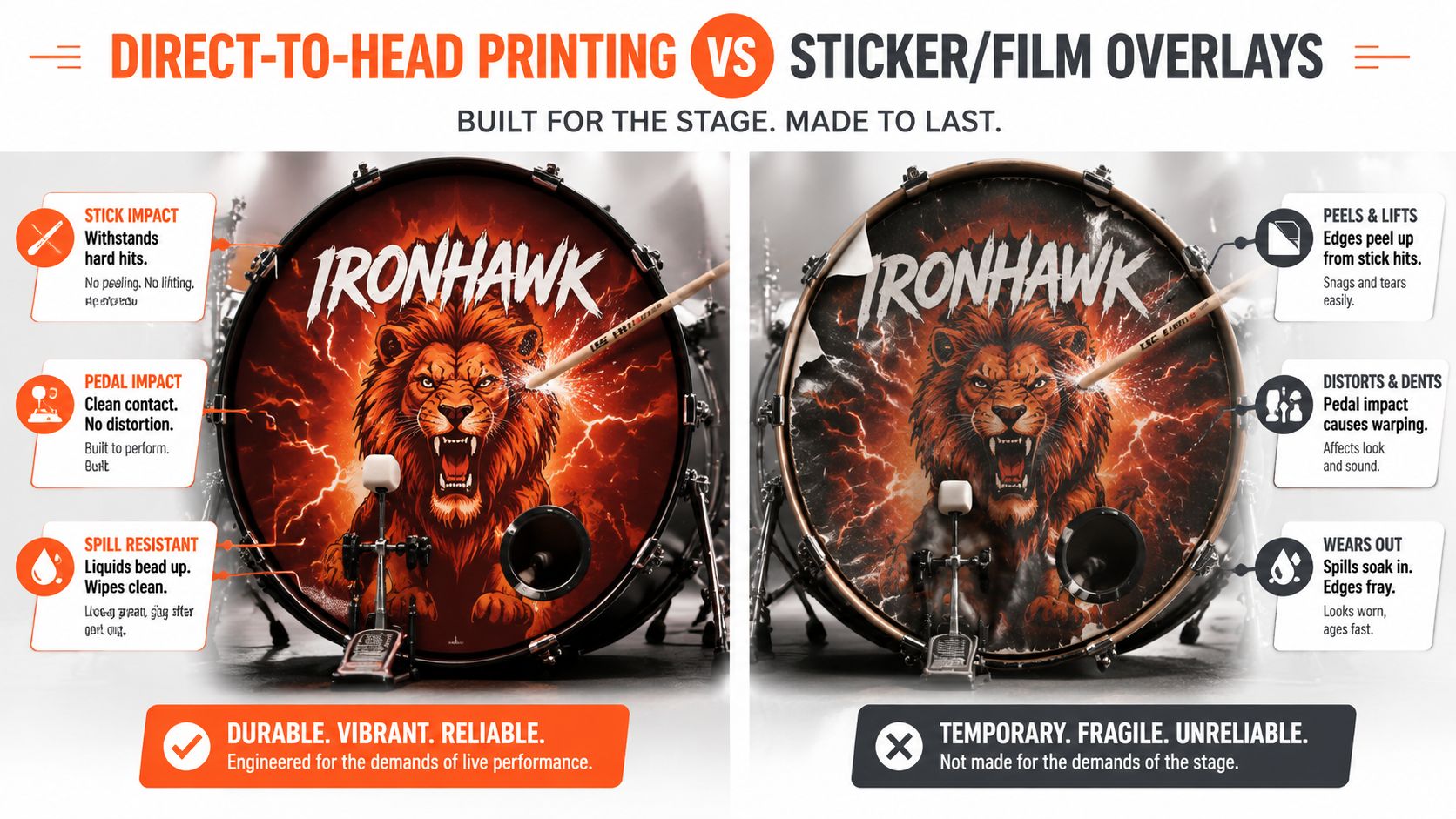
Stage conditions expose weak edges
The mic port is a stress point because it creates a cut edge in the head and often sits near the area where graphic material must be trimmed or handled. A poorly planned overlay can show wear around that opening. Direct printing avoids a separate film perimeter, though the artwork still needs sufficient clearance from the port and hoop.
The same logic applies to gaffer’s tape, sweat, and repeated setup. Tape should never be treated as a harmless design tool on the graphic surface. It can leave residue, pull at an applied layer, or make a temporary repair look worse than the original problem.
This does not make every direct print indestructible. Publicly available information does not provide neutral, head-to-head testing for abrasion, color fade, high-heat stage lighting, repeated port use, cleaning, or replacement cycles. The honest recommendation remains clear: for a head that will travel and be handled regularly, direct printing is the lower-maintenance format. For a stationary display or a carefully applied branding piece, an overlay may still fit the job.
Readers focused on the sound-side implications of a front head can also review the practical discussion in this bass drum tone guide, then keep the visual decision separate from the tuning decision. A striking logo will not compensate for a port placed through the artwork or a head ordered in the wrong diameter.
Which Custom Bass Drum Head Setup Fits Your Needs
The right choice changes with the ordering environment. A drummer buying one head can personally check every file and answer every email. A school, church, or touring crew has more people, more revisions, and more opportunities for someone to approve an outdated version.
Touring band with a replacement deadline
A touring four-piece needs a quick replacement that looks correct when it reaches the stage. CustomBassDrumHead.com fits this scenario because the buyer can upload the existing logo, position it in the browser, check the port, and approve one visible layout. The main risk is not creative direction. It is making a fast order with incomplete measurements.
The touring buyer should keep a production-ready logo file, record the actual shell diameter, and save the preferred port position. A replacement order should reproduce the established layout rather than introduce a new design under pressure.
School drum line with coordinated branding
A school ordering for a large drum line has a different problem. Budget review, purchase approvals, artwork signoff, and quantity pricing may matter more than a single head’s fastest possible mockup.
The school should request a written volume quote, identify every size, and designate one approver. A single rush order through an unclear review process is a poor fit when several students, teachers, and administrators are trying to make changes at once.
Worship team with seasonal artwork
A mid-size worship team ordering one head per quarter sits between the two. Rotating seasonal art rewards a fast visual workflow, while a varied kit can make sizing and port placement the more important issue. CustomBassDrumHead.com is the better fit when the team wants to repeat a controlled design process and approve each new graphic in the browser.
A church with a reliable designer and a stable proof process should still avoid changing the logo, diameter, and port position all at the same time.
| Buyer Profile | Best Fit | Why It Fits | Watch Out For |
|---|---|---|---|
| Touring four-piece | Browser mockup ordering | Fast visual confirmation supports a replacement order | Measure the spare or replacement drum before ordering |
| School drum line | Written volume quote with one approver | Centralized review can reduce confusion | Do not let multiple reviewers approve different files |
| Worship team | Recurring visual approval process | Repeat design review becomes more straightforward | Confirm every new artwork version against the same head size |
| Solo artist or hobbyist | Direct printed custom head | One buyer can upload, position, and approve the design | Avoid low-resolution artwork and crowded lettering |
| Production or backline provider | Standardized repeat ordering | Documented measurements reduce rework | Verify compatibility across every drum supplied |
The misfit pairings are easy to spot. A school should not place a single emergency order without confirming the full proof and delivery chain. A touring band should not chase an unusual port arrangement without checking that it can be shown clearly before production. The workflow has to match the buyer’s ability to review details before production.
The Shortlist and What to Order Next
For touring musicians and gigging bands, CustomBassDrumHead.com is the practical recommendation. The live mockup puts size, artwork placement, and port clearance in front of the buyer before production, which is exactly what a replacement order needs. A touring crew should not add an installation project to an already crowded travel schedule unless there is a specific reason to do so.
For schools and churches, the decision depends on who controls approval. A centralized team with one designer and a repeatable process can succeed with almost any vendor. A group with several reviewers and frequent artwork changes should use a browser-based workflow to reduce version confusion.
For solo artists, teachers, and hobbyists, CustomBassDrumHead.com is the simpler shortlist. Those buyers usually want one personalized head, a visible preview, and a finished product that does not require separate graphic application. They should still treat measurement and file preparation as essential.
Buyer checklist
- Print method: Decide whether the artwork should be printed directly onto the head or applied as a separate overlay.
- Mic port: Choose whether a port is needed and keep it clear of the logo, lettering, and focal artwork.
- Size verification: Measure the actual drum and confirm whether the design belongs on the resonant or batter head.
- Artwork format: Supply full-size artwork at a minimum of 300 DPI for raster files, with vector PDF preferred when available.
- Proof timing: Decide who has final approval and allow time for corrections before production.
- Shipping window: Confirm the current production and delivery schedule against the next rehearsal, session, or gig.
- Repeat orders: Save the approved layout, measurements, port position, and artwork version for future replacements.
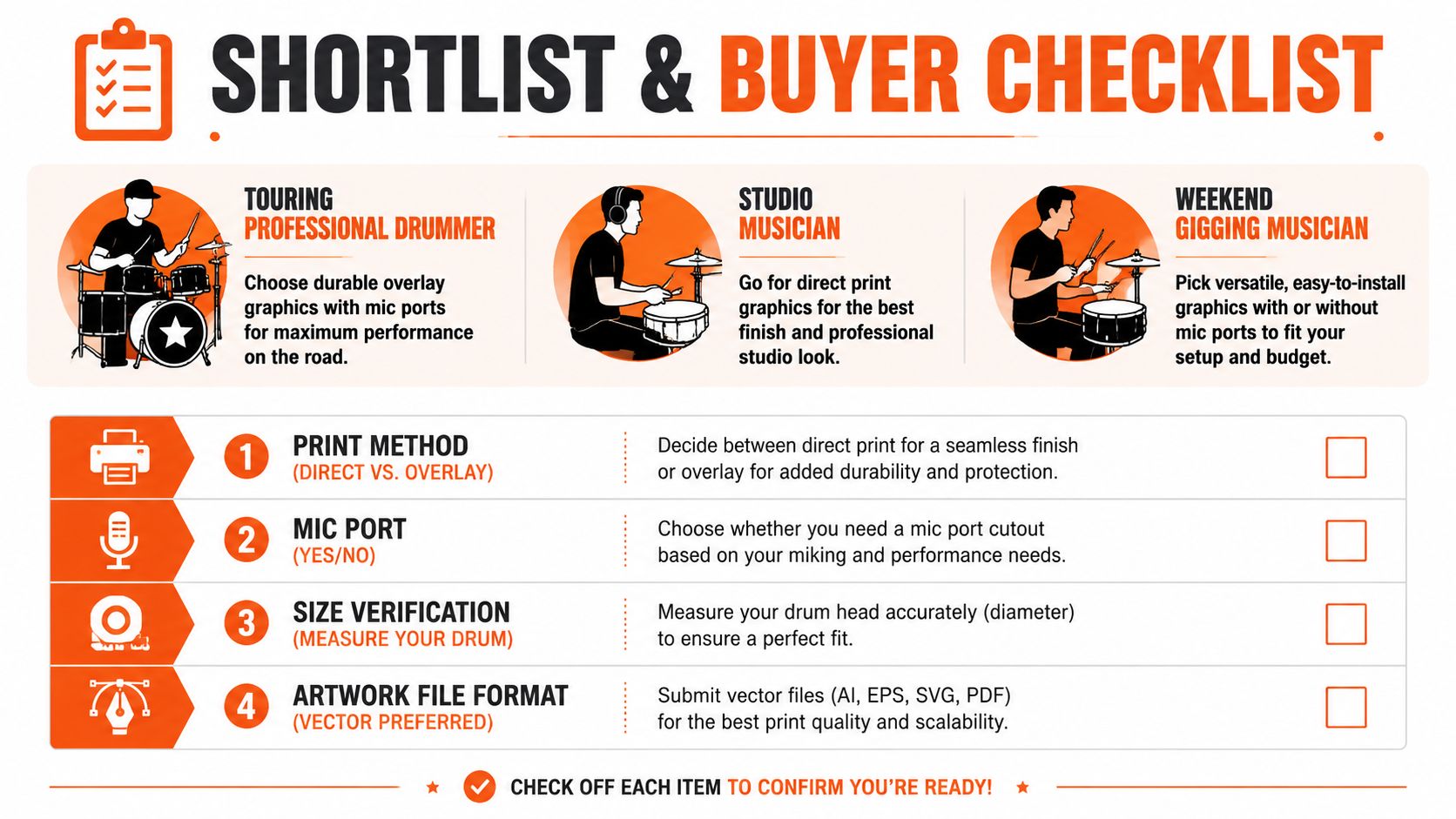
The final decision comes down to where the buyer wants the risk caught. A browser-based mockup catches more of the visual risk before production. A simple proof process relies more heavily on communication and the buyer’s ability to manage the review cycle. For a stage-ready custom printed head, visual approval before printing is the stronger default.
Short Buyer FAQ
What file type works best for a custom bass drum head?
Vector PDF is usually the safest option for logos and text because it scales cleanly. If you are using a raster file, prepare it at full size and at least 300 DPI.
Do I need a mic port?
Not always. Many buyers add one for easier microphone placement, but it should be planned before approval so it does not cut into the logo or small text.
How do I know what size to order?
Measure the actual drum head diameter instead of ordering from memory. Also confirm whether you need the resonant front head or the batter side.
Is a printed head better than a decal?
A direct printed head is usually the simpler choice when you want a finished product that is ready to install. A decal or overlay may require extra alignment and application work.
Should more than one person review the design?
Yes, if the order is for a school, church, or touring group. A shared visual mockup helps everyone approve the same layout before production begins.
Custom Bass Drum Head offers direct-to-head full-color printing, premium head options, and a browser mockup that lets buyers check artwork, sizing, and placement before production. Visit Custom Bass Drum Head to build the design against the actual head template, confirm the mic-port area, and approve a stage-ready graphic before the next gig cycle.