A custom bass drum head usually gets designed at the very end of the branding process. The logo is approved. The social graphics are done. The shirts are printed. Then someone looks at the front of the kit and realizes the most visible piece on stage still has to be right.
That’s where the printing method stops being a shop detail and becomes a band decision. A bass drum head isn’t just another print surface. It sits under lights, in photos, in videos, and dead center behind the singer or in front of the riser. If the artwork gets flattened, softened, or simplified, the whole visual identity loses impact.
For buyers comparing screen printed drum heads vs direct printed drum heads, the primary question isn’t which method sounds more old-school or more high-tech. It’s which one gives the stage-ready result the artwork requires, within the quantity, timeline, and budget the band is working with.
Your Band’s Logo on the Big Stage
A common situation goes like this. A band has a logo with a fade, a texture in the background, and thin lettering that matches everything else in the brand package. It looks clean on screen. It looks great on merch mockups. Then the bass drum head order starts, and suddenly the artwork has to fit the printing process instead of the other way around.
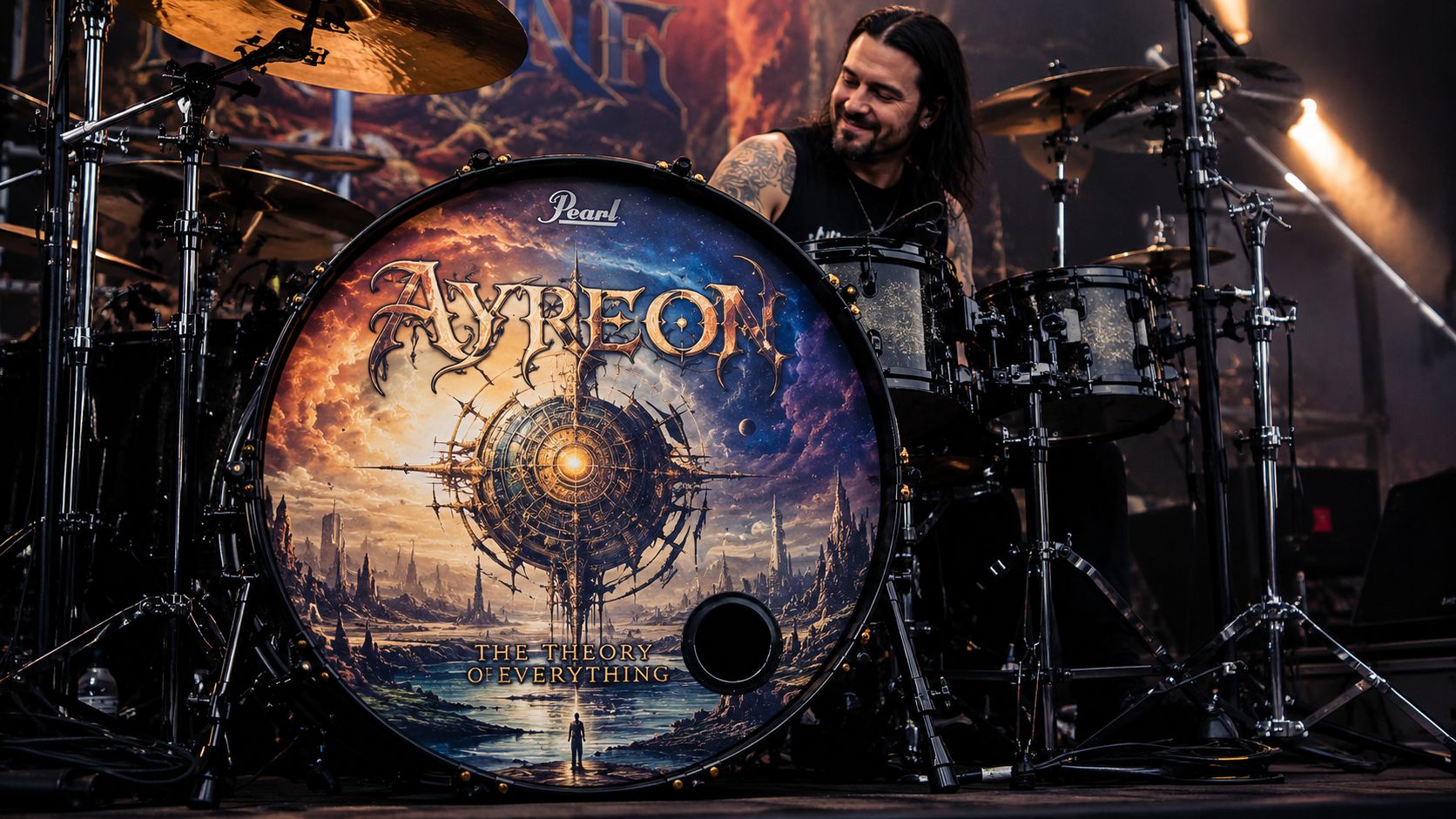
That’s why this choice matters so much for gigging musicians. The front head has to do two jobs at once. It has to survive handling, setup, transport, and stage use, and it has to represent the band exactly the way the audience already knows it.
A lot of buyers start with a design question, but what they’re really deciding is a production path. One path comes from the traditional screen-print workflow that dominated printed drum heads for years. The other uses direct UV printing, where the artwork is printed directly onto the head and cured with ultraviolet light, a newer process that also opened up printing on clear drum heads according to this direct-print overview.
The choice behind the artwork
The practical difference shows up fast:
| Decision point | Screen printing | Direct printing |
|---|---|---|
| Best fit | Simple spot-color graphics | Full-color artwork, photos, gradients |
| Order size | Better suited to larger runs | Works well for one-off or small runs |
| Artwork changes | More involved once setup starts | Easier to revise digitally |
| Stage branding accuracy | Strong for bold simple designs | Better for exact reproduction |
Bands that want ideas before locking in a file can Browse custom drum head designs and see what works on a full-size head under real-world conditions.
The front head is often the largest branded surface on stage. If the print method forces compromises, the audience sees the compromise first.
The Classic Method How Screen Printing Works
Screen printing earned its place in drum-head production because it solved a straightforward problem well. If a band wanted a bold logo in one or two solid colors and needed a sizable run, screen printing was dependable and familiar.
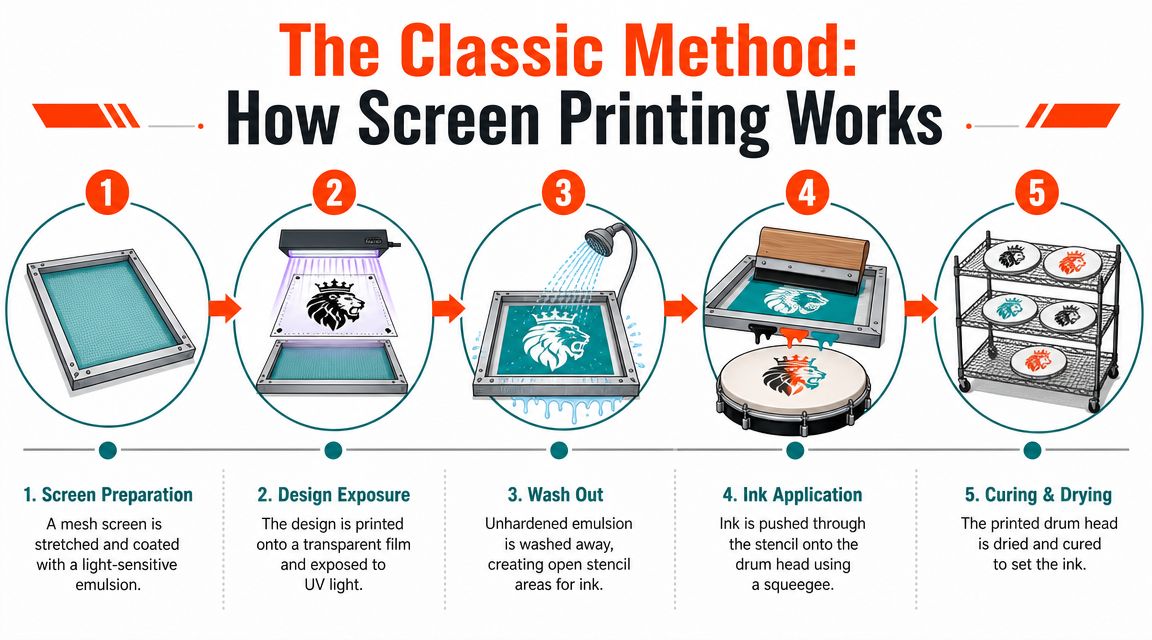
At its core, it works like a stencil process. A separate mesh screen is prepared for each color in the design. Ink gets pushed through that screen onto the drum head, then the next color is lined up and printed in another pass. That repeatable process is why screen printing historically dominated decorated drum heads.
What the process looks like in practice
A typical screen-print workflow usually involves these production realities:
- One screen per color: Every added spot color usually means another physical setup step.
- Layer-by-layer registration: The printer has to align each pass so shapes and edges land where they should.
- Prep before production: The shop generally has to build the screens before the first head is printed.
- Design simplification: Artwork often works best when it uses bold shapes and limited solid colors.
That process still makes sense for certain orders. A simple school logo, a clean one-color emblem, or a repeating graphic across many heads can fit the method well.
Why it worked for so long
Screen printing matched the way many drum-head graphics used to be designed. Older stage logos were often simpler, flatter, and built around spot colors anyway. In that environment, the process wasn’t a limitation. It was the standard.
The trouble starts when modern branding gets pushed into an older production method. A logo with soft fades, layered textures, or subtle color transitions doesn’t naturally break into a few spot-color screens. The more the art depends on smooth transitions, the more likely it is to be reduced, approximated, or rebuilt.
Practical rule: If the design only works after removing the gradient, thickening the fine lines, and dropping colors, the print method is driving the design too hard.
For buyers still sorting out artwork and layout, a solid drummer’s guide to custom drumheads helps clarify what belongs in the file before production starts.
Where screen printing still has a lane
Screen printing isn’t low quality. That’s not the issue. The issue is fit.
It still has a real use case when the order is large and the design is simple. A flat-color logo can print cleanly, and the economics can make more sense when the setup work gets spread across many heads. What doesn’t work as well is expecting that same workflow to reproduce photographic art, subtle fades, or detailed brand graphics without compromise.
The Modern Standard How Direct Printing Works
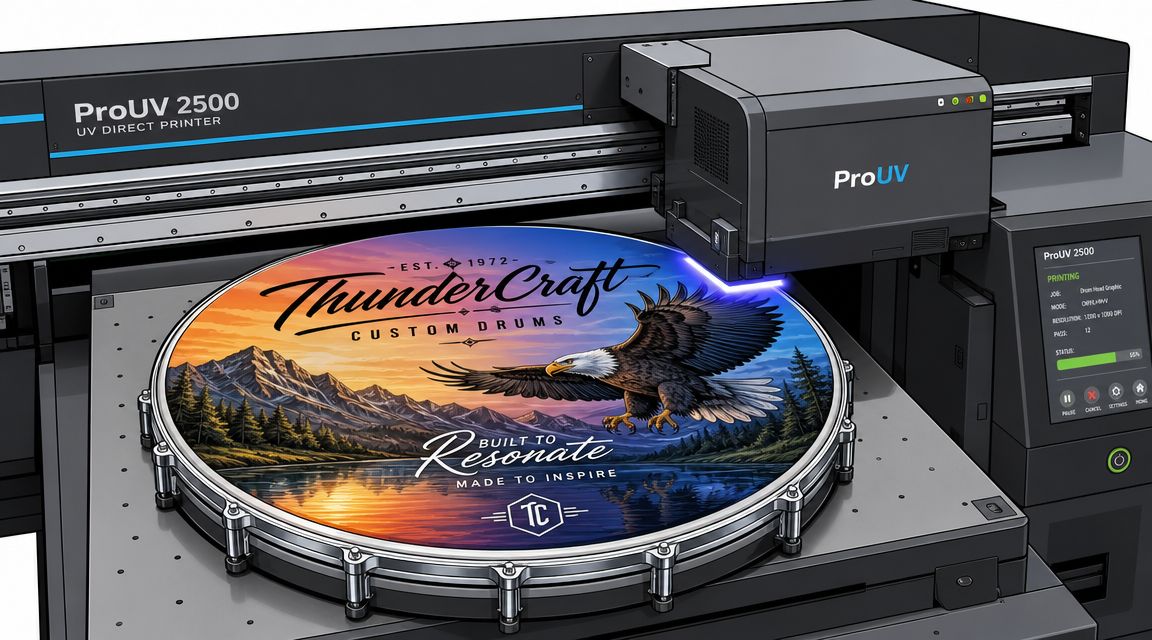
Direct printing changed bass drum head printing because it removed the biggest artistic bottlenecks in the old workflow. Instead of building separate screens and printing one color layer at a time, the printer applies the design directly to the drum head surface and cures it with ultraviolet light.
That matters to a buyer because the digital file becomes the production starting point. There’s no need to translate a full-color design into a handful of spot-color layers just to make the job printable. If the file is built properly, the printed head can follow the artwork much more closely.
What direct printing changes for the buyer
Direct digital or UV printing is the reason custom bass drum heads became practical for more than just large group orders. The major advantages are straightforward:
- No minimum order quantity: A single drummer can order one head without waiting to justify a batch.
- No setup fees per color: Full-color work doesn’t trigger a separate screen-building charge for each added hue.
- Better artwork fidelity: Multi-color gradients, photos, textures, and fine line work can reproduce as designed.
- Faster turnaround: The process skips the screen-prep stage that slows traditional jobs.
For independent bands, worship teams, teachers, and one-off event builds, that no-minimum advantage is often the deciding factor. Most musicians don’t need a stack of matching heads. They need one or two that look exactly right.
File quality matters more than old-school separations
Modern printed drum heads also expect cleaner digital prep. One supplier specifies final artwork as a CMYK PDF at vector or 300 dpi resolution, and notes that advanced UV printers can produce both matte and gloss finishes simultaneously while printing on clear, holographic, and sparkle-faced heads in a single workflow, as described in its print file and finish guidance.
That tells buyers two useful things. First, direct printing rewards good files. Second, it opens creative options that aren’t limited to flat graphics on standard surfaces.
Smooth gradients are usually the clearest dividing line. Direct printing can reproduce the blend as designed, instead of forcing it into flat color stops or a coarse visual workaround.
A drummer ordering a custom head for a release show, session video, or regional tour usually cares less about print-shop tradition and more about what arrives in the box. If the approved artwork includes a photo background, a subtle shadow, or delicate script, direct printing is usually the method that keeps the design intact.
The Side-by-Side Showdown
The easiest way to compare screen printed drum heads vs direct printed drum heads is to stop thinking like a printer and start thinking like a band loading into a venue. The head has to look right from the pit, from the crowd, and in a phone photo posted ten minutes after downbeat.
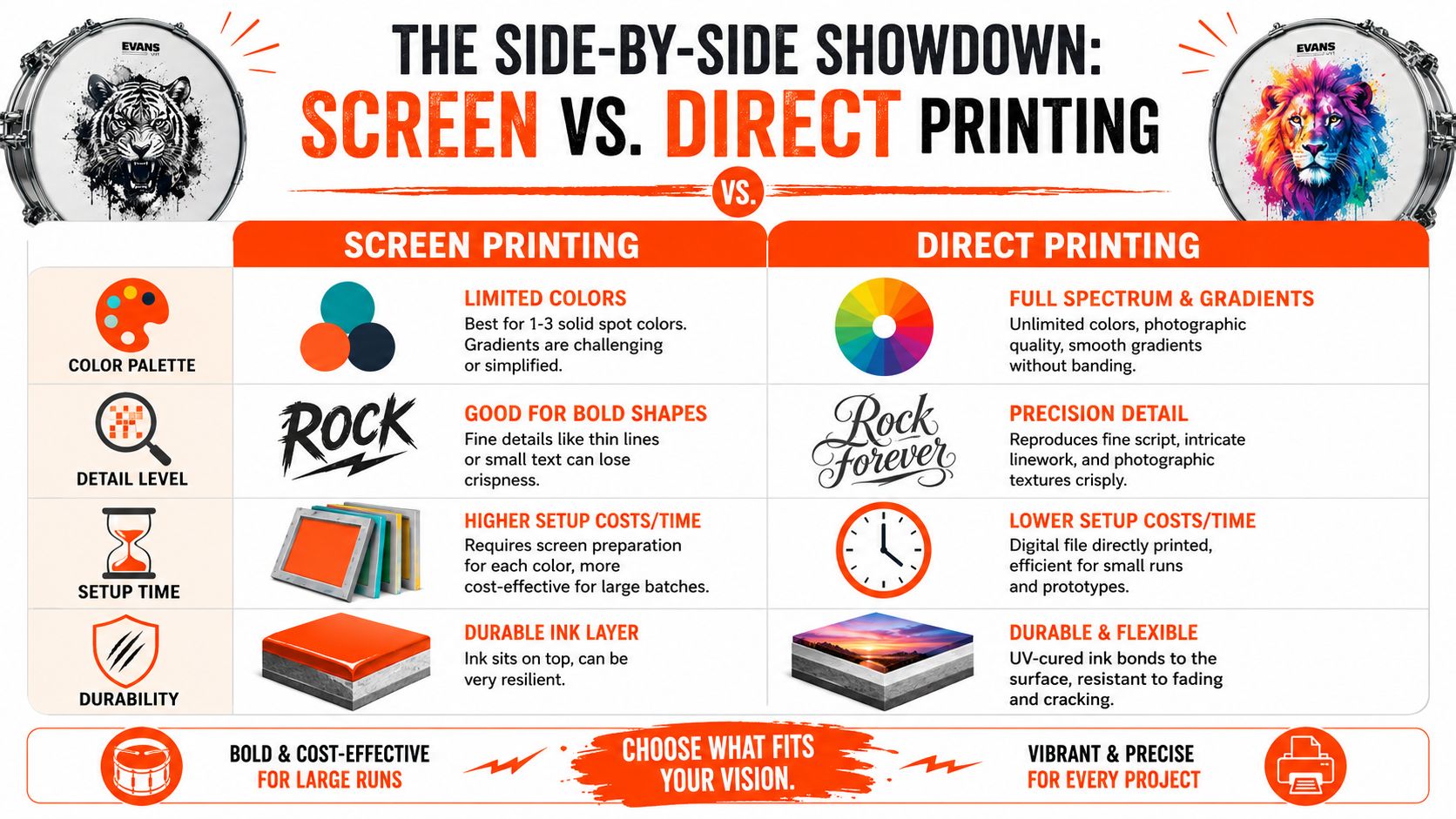
Quick comparison table
| Category | Screen printing | Direct printing |
|---|---|---|
| Color handling | Best with limited spot colors | Full-color output |
| Gradients and photos | Often simplified or approximated | Reproduces photographic-quality artwork |
| Fine detail | Better for bold shapes | Better for thin script and intricate linework |
| Durability approach | Ink sits in printed layers | Artwork is printed direct to the head |
| Order quantity | Often better suited to larger runs | No minimum order quantity |
| Turnaround | More prep before printing | Faster for one-offs and short runs |
Visual quality and brand accuracy
Modern buyers feel the difference immediately. Screen printing can look excellent on bold, simple art. A clean emblem, a single-color mark, or a straightforward two-color design can come out sharp and stage-ready.
But complicated branding is where the trade-off gets exposed. One touring band ordered heads for a regional run using a screen-print process. Their logo used a gradient, and the print shop told them it had to be simplified into two flat colors to be produced at all. The finished heads didn’t match the band’s existing branding, so the visual identity on stage looked off before the first show even started.
A direct-printed replacement solved the problem because the original full-color file could be printed as designed, including a photographic texture in the background.
Gradients and photographic detail
Screen printing struggles when a design depends on smooth transitions. A fade from red to orange to white often gets reduced into flat color blocks or approximated in a way that loses the original feel.
Direct printing handles that kind of art far better. It can reproduce photographic-quality images and multi-color gradients without setup fees, which is a major reason digital bass drum head printing has become the default choice for small bands and solo artists.
If the artwork includes a photo background, soft glow, smoke texture, watercolor blend, or detailed illustration, direct printing usually preserves the design instead of translating it.
Durability and road use
Durability matters differently on a drum head than on a poster or banner. A bass drum head gets packed, leaned against cases, mounted, unmounted, and exposed to changing temperatures. That’s why the bond between the graphic and the head matters.
Direct-to-head printing avoids the edge-lift, bubbling, and long-term issues associated with sticker or film graphics, and it can also support opaque white underprinting on transparent heads plus simultaneous matte and gloss effects, according to this direct-to-head printing overview.
In road use, a common failure point on more layered print approaches is the boundary where separate ink passes build up. That’s also where some players first notice visible cracking or wear. By contrast, direct printing tends to hold up better when the buyer wants the artwork integrated into the head surface rather than sitting like an added layer.
Cost per unit and minimum quantity
Screen printing can make sense when the order is large enough to justify setup. That’s the classic strength. If many identical heads are being produced and the art is simple, the setup burden gets spread across the run.
That logic doesn’t help the average independent drummer. Most buyers in this category need one head, maybe two. They don’t want to pay for a process built around batch economics, and they don’t want to redesign the logo just to satisfy the production method. Anyone comparing the cost of a custom bass drum head should weigh not just the unit price, but also the creative compromises and quantity requirements behind it.
Turnaround time
Lead time is often the silent deal-breaker. Screen printing requires physical prep for each color before production starts. That adds time before the first usable print even exists.
Direct printing skips that pre-press buildout. For small orders, that often means a noticeably faster path from approved artwork to a stage-ready head. When a drummer has a release show, a fly date, or a short tour coming up, that difference matters more than shop nostalgia.
Choosing the Right Print for Your Gig
The best printing method depends on the actual job. Most buyers don’t need a philosophical answer. They need to know which option fits their design, timeline, and stage use.
The touring band
A touring act usually needs two things above all else. The artwork has to match the brand exactly, and the head has to keep looking right after repeated load-ins.
That’s where direct printing usually wins. Tour visuals now include gradients, textures, layered colors, and artwork pulled from album campaigns or social assets. Direct printing handles that kind of brand consistency better, especially when only one or two heads are needed for the run.
The solo artist or content-focused drummer
This buyer often needs a single head for stage content, sessions, livestreams, or promo shoots. Minimum quantity becomes a major issue fast.
Direct printing makes more sense here because there’s no need to meet a batch requirement just to get one polished result. A service such as custom marching heads can also make sense for players or programs that need larger-format or specialty use cases without giving up full-color flexibility.
The school, line, or large group order
This is the category where screen printing still deserves consideration. If a program needs a large order and the design is simple, often a one-color or limited-color mark, the older method can still be practical.
But schools and organizations should be honest about the artwork. If the crest, mascot, or sponsor layout depends on detail, gradients, or specialty surfaces, direct printing becomes more attractive very quickly.
Don’t overestimate the sound difference
A lot of buyers worry that the print method itself will reshape the drum’s tone. In practice, the head construction matters much more. Single-ply heads are typically around 10 mil, while double-ply heads are typically around 7 mil + 7 mil, and that construction difference affects sustain, overtones, control, and durability far more than the decoration method, as explained in this drum head construction guide.
Choose the sound with the head type. Choose the look with the print method.
For most modern custom bass drum heads, the practical answer is simple. If the design is detailed, the order is small, or the schedule is tight, direct printing is usually the right call. If the design is extremely simple and the order is very large, screen printing can still make sense.
Frequently Asked Questions About Custom Drum Heads
Buyers usually narrow the choice down to one method, then hit the same three questions before ordering.
Will printing affect the sound of the drum head
Usually far less than people expect. The bigger factors are the type of head, the ply count, whether it’s built for resonant or marching use, and any dampening choices.
A neutral explanation of the issue makes the point well. The printing process itself is secondary to the head’s construction, and the sound is primarily driven by head type, ply count, and dampening rather than the visual decoration method, according to this bass drum printing and sound discussion.
That’s why buyers should first choose the right head for the job, then choose the print method that suits the artwork.
What file should be sent for bass drum head printing
The cleanest path is a print-ready file built at final size. In practical terms, that usually means:
- Vector artwork when possible: Logos and text stay crisp at any scale.
- High-resolution raster art when needed: If the design includes photos or painted textures, use a file prepared at final size and suitable print resolution.
- CMYK setup: This helps align the artwork with print production rather than screen-only color expectations.
- Transparent background when appropriate: That matters if the design uses the head material itself as part of the look.
One straightforward option in this category is Custom Bass Drum Head, which lets buyers upload artwork, place the design on the head, and review the visual before production at its order page. The key point isn’t the platform. It’s that modern direct printing works best when the file is prepared cleanly from the start.
How should a printed drum head be cared for
Good care is mostly common sense, but it matters.
- Transport carefully: Keep the front head from rubbing against hardware, stands, and loose metal parts in transit.
- Wipe gently: Use a soft cloth rather than anything abrasive.
- Avoid added adhesive layers: Tape, stickers, and temporary overlays can create avoidable wear points.
- Store flat and protected: Don’t let the printed face get scuffed in a trailer or case pile.
A custom front head is part instrument, part branding asset. Treating it that way keeps it camera-ready longer.
Design Your Stage-Ready Head Today
For most buyers, the decision comes down to what the artwork demands. If the design is simple and the order is large, screen printing can still be a reasonable fit. If the design includes gradients, photo elements, subtle textures, or detailed branding, direct printing is usually the stronger choice. It also makes more sense when only one or two heads are needed and the deadline is tight.
The easiest next step is to stop guessing how the art will translate and design and order your drum head with the actual file in place.
Custom stage branding works best when the head looks the way the band intended from the start. Custom Bass Drum Head makes it possible to upload artwork, review the layout, and order a printed head built for real-world stage use without forcing the design into an older print limitation.