
A custom bass drum head usually starts as a fun idea. A band logo on the front head. A clean monogram for a session kit. A graphic for a church stage, a school ensemble, or a one-off show. Then the buying decision gets serious fast, because the front head sits at eye level for the crowd, the camera, and the client.
That’s why the key question isn’t just which company can print a cool-looking graphic. The better question is how to choose a custom drum head printing company whose process makes a bad outcome unlikely before the order ever reaches production.
A polished product gallery can hide a messy workflow. A trustworthy workflow usually shows its quality early: how the company handles files, how it proofs artwork, how clearly it talks about materials, and whether it can answer practical fit and shipping questions without dodging them.
The Difference Between Stage-Ready and a Sad Surprise
One of the most common buying mistakes happens before the order is placed. A drummer finds a marketplace seller with a few appealing photos, sends over a logo pulled from social media, and assumes the rest will sort itself out. The head arrives looking acceptable in the box, then the problems show up under stage light. The black logo prints charcoal. Fine lines look jagged. Curves around the lettering show pixelated edges. The port hole lands in the wrong place, or there isn’t a clean one at all.

That kind of seller usually reveals the risk in hindsight. No digital proof. No clear file requirements. No explanation of the print method. No meaningful support when the finished head doesn’t match expectations. A low price can end up buying a one-show prop instead of a stage-ready drum head.
By contrast, a professional process feels controlled from the start. The buyer can review placement, scale, bleed, and mic-port position before anything goes into production. The company can show examples of installed results, not just cropped product photos. A gallery like Custom Bass Drum Head’s portfolio helps because it shows what printed drum heads look like on real kits, under real use.
What separates a real shop from a hobby seller
A reliable provider usually does four things well:
- Screens the artwork early so weak files get caught before printing.
- Shows a proof before production instead of asking the buyer to trust a description.
- Explains the print process clearly rather than hiding behind vague phrases.
- Supports practical stage needs like size options and port placement.
A custom head should look intentional from the audience, the photo pit, and the drummer’s throne. If it only looks good in a listing image, that’s not enough.
Checklist summary: A good answer sounds like this. “You’ll see and approve the actual layout before production, and the company can explain exactly how the head is printed and how it will look when installed.”
Evaluating Print Quality and Material Durability
The biggest quality divide in custom drum heads is the print method. That matters more than flashy mockups, more than trendy finishes, and more than a seller’s social feed.
The standard worth looking for is true direct-to-head printing. That’s the method associated with major manufacturers and specialty providers, and it’s a strong quality signal because it preserves the feel of the head rather than adding a separate layer on top. Market offerings in this category also support professional bass drum head sizes from 16-inch through 26-inch for resonant heads, which is a practical benchmark for stage and studio kits, not just novelty pieces, as shown on D’Addario’s custom drumhead information.

Direct printing versus applied graphics
Cheap custom heads often rely on a sticker, film, or overlay approach. That can work for a quick visual, but it creates trade-offs that matter once the head is mounted, tensioned, transported, and used.
A direct-printed head is generally the safer route because the printed surface isn’t acting like a separate decal. The practical benefits are straightforward:
- Sound and feel stay closer to a normal head because direct printing is described as adding no noticeable thickness or stiffness.
- The finish is less vulnerable to peeling edges and trapped bubbles than applied graphics.
- The result looks more integrated under stage light, especially on large dark areas and curved letterforms.
Sticker-like methods often look fine in a straight-on product shot. Problems show up later. Edges can lift. Trapped air becomes visible. The surface can look like a graphic attached to a drum head instead of a drum head designed that way in the first place.
For a deeper explanation of that distinction, this comparison is useful for drummers choosing custom heads.
Durability questions that matter in real use
A custom bass drum head doesn’t live in a showroom. It goes into cases, trailers, church closets, rehearsal spaces, classrooms, and damp stages. It gets mounted and removed. It sits under lights. It gets wiped down. Sometimes it gets hit by hardware or a careless stick.
That’s why a serious buyer should ask not only how the head looks on day one, but how the company talks about durability under playing conditions. A professional shop should be able to discuss wear, handling, and the trade-offs between a premium printed head and cheaper applied methods in plain language.
Practical rule: If a seller talks a lot about artwork and almost nothing about construction or durability, that’s a warning sign.
A useful way to evaluate the answer is this short comparison:
| What to ask | Better answer | Weak answer |
|---|---|---|
| How is the graphic applied? | Printed directly onto the head | “It’s custom printed” |
| Will it affect the head? | Explains how the process preserves the head surface | Avoids the question |
| How does it hold up? | Talks about transport, moisture, mounting, and wear | Only says it looks great |
Checklist summary: A good answer sounds like this. “The artwork is printed directly onto a quality drum head, not applied as a sticker or film, and the company can explain how that holds up on real gigs.”
Why the Digital Proofing Process Is Non-Negotiable
Most custom drum head disappointments aren’t print failures. They’re approval failures. The company printed exactly what it received, but the buyer never got a meaningful chance to catch the bad crop, the low-resolution logo, the off-center text, or the wrong port placement before production started.
That’s why the proofing process is the strongest signal of whether a company respects the buyer’s order and understands custom work.
A reputable provider should offer a digital proof approval process before any head goes to production. Not a vague email that says “looks good.” Not a cropped thumbnail. A real preview that lets the buyer judge proportion, placement, background coverage, and port location on the actual head layout.
According to this guide to artwork specs for custom drum heads, the strongest browser-based tools accept vector files and high-resolution raster files, and they allow resizing, rotation, centering, layering, bleed review, and mic-port verification. The key idea is simple: what the buyer approves in the mockup should be what gets printed.
The marketplace seller problem
The cautionary example is familiar. A drummer orders from an Etsy-style seller because the listing promises a custom printed drum head with a fast turnaround. The seller asks for a logo file through messages, sends no proof, and confirms the order with a short “got it.” When the head arrives, the artwork has obvious stair-stepping on the edges and the color is visibly off under light.
The problem isn’t only the print result. The problem is that there was no checkpoint built into the process. No one flagged the weak file. No one showed the final layout. No one confirmed whether the proof represented the printed outcome.
A reputable provider would have handled each stage differently:
- At file intake: The artwork would have been checked for compatibility, especially if the file came from a web image or screenshot.
- Before production: The buyer would have received a digital mockup for approval.
- At layout review: Bleed, scale, and port placement would have been visible.
- Before final signoff: The buyer would have known the approved proof governed production.
Why proofing matters even more on a mounted drum
A bass drum head isn’t a flat poster. It’s tensioned, curved, and viewed from different angles. That creates buyer anxiety around logo placement, edge spacing, and whether the screen preview will still look right after installation.
One of the most overlooked concerns in this category is proof of print accuracy on a curved, stretched surface. Good sellers understand that worry and build their workflow around reducing surprises. They don’t just let buyers upload art. They show what the installed result is expected to look like before payment moves into production.
The proof should answer the question the buyer actually cares about. “What will this look like on the drum?” Not “Did the file upload?”
What to inspect before approving a proof
A buyer should slow down at this stage. It’s an opportunity to catch expensive mistakes cheaply.
- Look at edges closely. Fine line art, small text, and sharp curves reveal low-quality source files quickly.
- Check the background intentionally. White, transparent, black, and full-bleed color behave differently visually.
- Verify the port position. It should match the mic setup and visual balance of the design.
- View the layout at full size if possible. A small on-screen mockup can hide scaling problems.
One provider that fits this process-focused model is Custom Bass Drum Head, which offers in-browser design and proof review before printing. That matters less as a brand point than as a workflow point. The buyer can see the design, approve it, and know the mockup is meant to govern the printed outcome.
Checklist summary: A good answer sounds like this. “Yes, the buyer must approve a detailed digital proof that shows artwork placement, bleed, and exact mic-port position before production begins.”
Confirming Sizing Compatibility and Custom Options
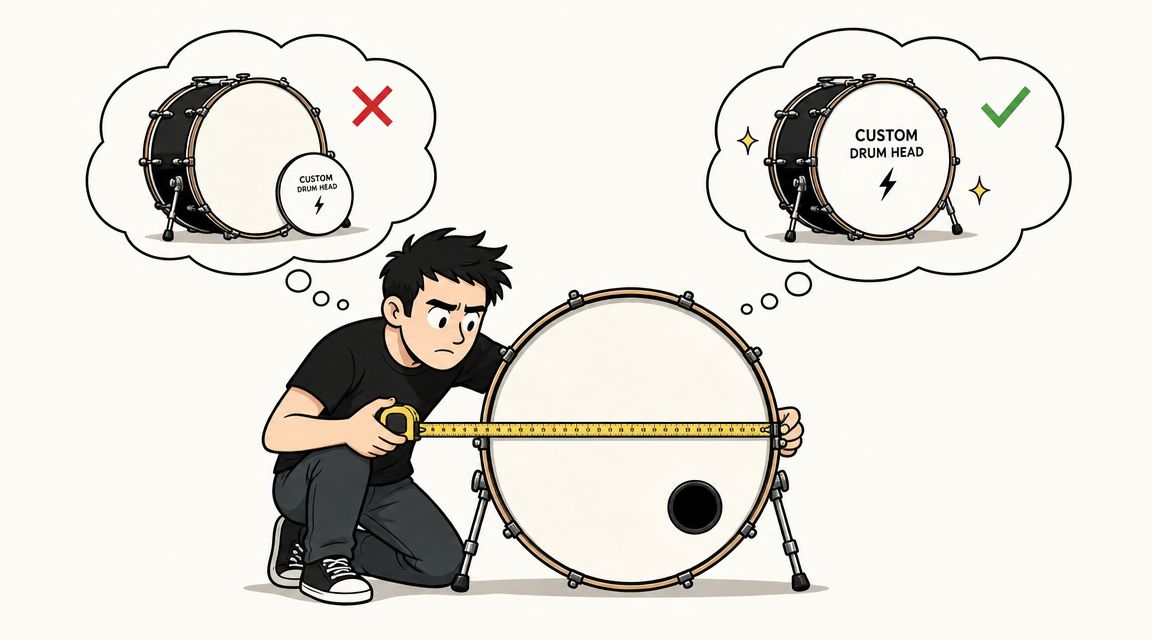
A custom design can be perfect and still be wrong if it doesn’t fit the drum, the hoop, or the stage setup. Fit questions should get answered before anyone talks about ink, color, or turnaround.
The first thing to confirm is whether the company supports a wide range of drum head sizes from major manufacturers. A serious shop should work with standard bass drum dimensions used on stage and in studios, not only a narrow souvenir-style catalog. Professional custom workflows in the category include common bass drum options and other head types, which shows the importance of broad compatibility rather than novelty-only production.
Size first, artwork second
A buyer should confirm the actual drum size and the type of head needed before uploading art. Resonant heads, batter heads, ported heads, and display-style heads serve different purposes. If the company treats all of them as interchangeable, the buyer should be cautious.
Clear measurement guidance is helpful. A sizing guide like sizing your custom bass drum head can prevent ordering the right design on the wrong diameter.
A practical size review should include:
- Drum diameter rather than a guess based on brand or shell depth.
- Head type needed for front-of-kit use versus actual playing surface use.
- Hardware and hoop clearance if the design runs close to the edge.
- Port requirement if the setup uses an internal microphone or specific airflow preference.
Port placement is not a minor detail
Mic-port options tell a buyer a lot about the company’s mindset. A one-position-only port suggests a templated workflow. A flexible workflow suggests the seller understands how drummers set up kits.
The higher-level concern underneath that is predictability. Some sellers discuss file upload and design tools but don’t really prove how the final print will align once the head is tensioned and mounted. That uncertainty matters because the buyer isn’t judging a flat file. The buyer is judging the installed look on a curved surface.
A custom head company should talk about fit the way a drum tech would. Size, placement, mounting, and practical use all matter together.
A strong vendor should be able to explain which head types are available, which sizes are supported, whether standard kit dimensions are covered, and how the mic port can be positioned for the drummer’s setup.
Checklist summary: A good answer sounds like this. “The company supports the required bass drum size, offers the right head type, and lets the buyer choose practical details like mic-port placement.”
Understanding Turnaround Times Shipping and Support
A custom order is still a real gig item. If the head is needed for a tour date, a video shoot, a festival, a worship conference, or a school performance, timing matters almost as much as print quality.
The first thing to watch is how the company talks about turnaround. A realistic provider separates proofing time, production time, and shipping time. A vague promise like “ships fast” isn’t enough. A buyer needs to know when the clock starts. Is it after checkout, or after proof approval? If the artwork needs cleanup, does that delay production? Those details tell the truth.
Turnaround red flags
There isn’t one perfect timeline for custom bass drum heads, because artwork complexity, proof revisions, and destination all affect the order. Still, a few patterns usually signal trouble.
- No distinction between production and transit. That often leads to disappointed buyers.
- No mention of approval timing. Custom work can’t move responsibly without a proof checkpoint.
- Overconfident rush promises with no process detail. That can suggest outsourcing or corner-cutting.
- Slow or unclear replies before purchase. Support rarely improves after payment.
Shipping quality matters too. A printed head is light, but it isn’t indestructible. The company should pack it in a way that protects the hoop edge and printed surface during transit. If a seller can describe design options in detail but can’t explain packaging or replacement handling, that’s worth noticing.
Why no minimum matters
Minimum order requirements can disqualify a provider for the exact people who buy custom drum heads most often. Solo artists, weekend bands, teachers, church drummers, and small studios usually need one head, not a production run.
That’s why no-minimum ordering matters. It keeps the service practical for independent buyers instead of forcing them into a bulk model built for organizations. Bulk pricing can still be useful for schools and production teams, but a one-off order should remain possible.
Support also deserves more scrutiny than most buyers give it. This isn’t a generic poster print. The company should understand drum sizing, front-head use, file prep, ports, and stage concerns. Buyers should ask direct questions and judge the answers. If the replies feel scripted or evasive, that’s information.
Buyer check: Ask one practical question before ordering. The speed and clarity of the response often tells more than the product page.
For buyers who want a direct order path instead of a quote-heavy process, it helps when a provider lets them get a fully custom, photo-quality drum head without forcing a bulk inquiry first.
One more support question belongs here. Ask how the company thinks about real-world wear after shipping. Public-facing content in this category often highlights appearance but says less about transport, moisture, repeated mounting, and abrasion. A professional provider should be able to discuss those conditions in a grounded way, because that’s how gigging use works, as reflected in guidance on durability and maintenance under gig conditions.
Checklist summary: A good answer sounds like this. “The company gives a clear production timeline, explains shipping plainly, supports one-off orders, and answers practical questions like a shop that understands both drums and print.”
Your Final Checklist and Questions to Ask Any Vendor
A good custom drum head company usually reveals itself through process, not hype. The more specific and transparent the workflow is, the less likely the buyer is to end up with a blurry logo, a bad fit, or a head that looked better online than it does on the drum.
The short vendor checklist
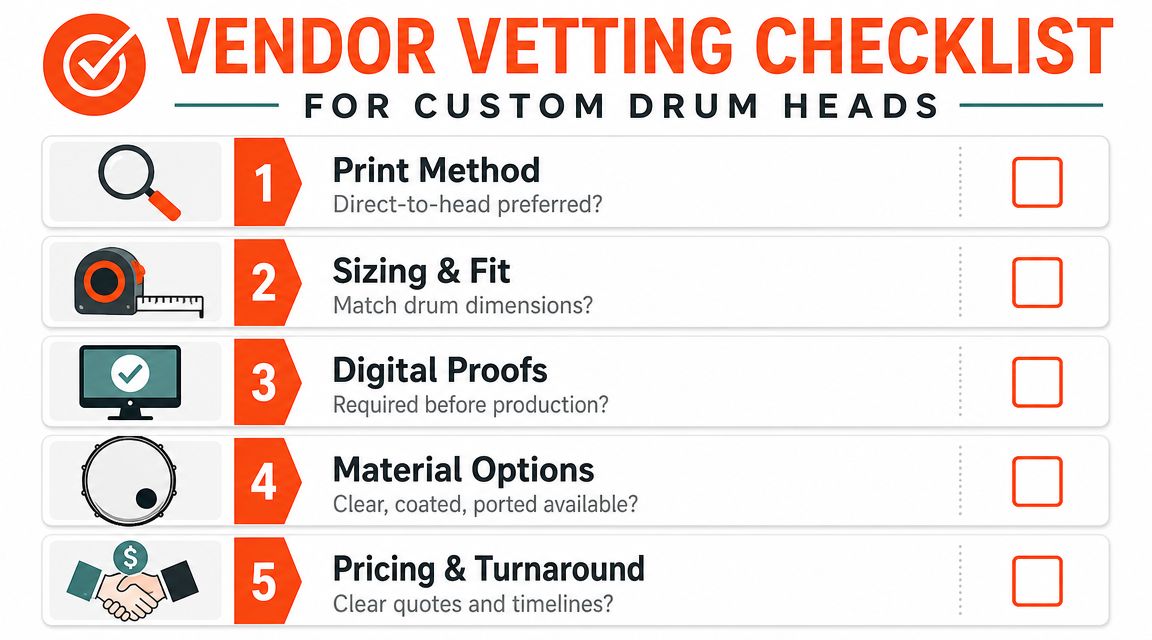
Use this as a practical screen when comparing providers for custom bass drum heads, printed drum heads, or bass drum head printing.
- Print method: Ask whether the graphic is printed directly onto the drum head or applied as a separate layer.
- Proofing workflow: Confirm that production doesn’t begin until the buyer approves a digital proof.
- Artwork handling: Make sure the company accepts appropriate file types and can flag weak files before print.
- Sizing and options: Verify that the needed drum size, head type, and port placement are supported.
- Order flexibility: Check whether one-off orders are allowed or whether the company forces bulk runs.
- Logistics: Look for clear production timing, sensible shipping expectations, and responsive support.
Questions worth emailing before ordering
These questions cut through vague marketing language fast.
- Is the design printed directly onto the head, or is it a decal, overlay, or sticker-based application?
- Will the buyer approve a digital proof before the order goes into production?
- Does the proof show bleed, full artwork placement, and exact mic-port position?
- What file types work best for logos, photos, gradients, and fine line art?
- What happens if the uploaded artwork is too low resolution for a clean result?
- Which bass drum sizes and head types are available?
- Can the mic port be placed where the kit setup requires it?
- Are one-off custom drum heads available, or is there a minimum order?
- How is turnaround explained? Is it separated into proofing, production, and shipping?
- Who handles support if the buyer has a fit, file, or layout question before ordering?
How to read the answers
The strongest answers are direct. They describe the workflow in plain language. They don’t dodge the print method, hide the proofing step, or assume the buyer should know what “custom printed” means.
Weak answers are usually broad and cheerful. “We can print anything.” “Just send the logo.” “It should be fine.” That kind of language belongs to a novelty purchase, not to a drum head that needs to hold up visually and physically on stage.
The process is the product. A company that handles proofing, file prep, fit, and logistics carefully is far more likely to deliver a head that works once it’s mounted.
A buyer comparing vendors can use this whole guide as a filter. If a company can answer these questions cleanly, show how its workflow prevents mistakes, and support real-world stage needs, it’s probably worth trusting. If not, it’s better to keep looking before the order becomes a regret.
Checklist summary: A good answer sounds like this. “The website and support team can explain print method, proof approval, file handling, size compatibility, order flexibility, and delivery expectations without leaving gaps.”
If those are the standards being used to evaluate custom drum heads, see how we approach custom bass drum head printing. The ordering workflow is built around proof approval, direct-to-head printing, practical size and port options, and the kind of predictable process buyers need when they’re ordering custom bass drum heads for actual stage use.