
The popular advice is wrong. Bass drum decals are not automatically the cheaper option, and they’re definitely not the cleaner one once the kit starts working for a living. A decal can look smart on day one, then turn into extra labor, extra handling, and extra replacement work the first time the head gets swapped, scuffed, or refused by a textured surface.
A better way to look at bass drum decals vs custom bass drum heads is this, which one stays stage-ready for your real use case. If the front of the kit is mostly a display surface, a decal can be a smart move. If the drum is going on the road, getting mic’d, or taking repeated setup and teardown, a printed head usually makes more sense.
| Criterion | Bass Drum Decal | Custom Printed Head |
|---|---|---|
| Surface fit | Works best on smooth heads, struggles on coated or textured heads | Built as the head itself, so the art is part of the finished surface |
| Setup | Applied by hand after the head is on the kit | Arrives ready to mount |
| Port flexibility | Often a problem if the head already has a port | Can be ordered with the port planned into the design |
| Durability | Replaceable, but more exposed to edge lift and install issues | More integrated and built for handling |
| Best use | Swaps, short runs, reusable artwork | Regular gigging, branding, and long-term use |
Why the Decal Versus Custom Head Question Matters More Than It Looks
The cheapest-looking option is often the one that costs more after the second or third changeover. A decal seems simple because the graphic is separate from the head, but that also means every head swap brings another round of alignment, cleaning, and install time. That matters more than most drummers admit, especially when the front head is a working part of the kit rather than a display piece.
Bass drum art has been around long before printed film existed. Pipe bands were painting names and identifiers onto calfskin heads more than a century ago, and by the 1920s shield-style logos had become common enough to define the look for a generation of players, with figures like Buddy Rich and Gene Krupa helping make it iconic. The big turning point came with synthetic heads in the 1950s, after Chick Evans invented the plastic drumhead in 1956 and Remo Belli and Sam Muchnick developed a Mylar polymer head in 1957, which made stable branding far more practical in humidity and temperature swings, as explained in this historical account.
Practical rule: if the front head is changed often, anything that sits on top of it should be judged as a recurring labor cost, not a one-time graphic purchase.
That’s why this decision isn’t really about “decal or custom” in the abstract. It’s about whether the artwork has to survive real use, real setup speed, and real stage conditions. If the answer is yes, the printed head usually wins because the art and the head age together instead of fighting each other. If the answer is no, and the same graphic needs to move from head to head, the decal has a legitimate job.
For a deeper look at when a bass drum head should be replaced, see this replacement guide.
What Counts as a Bass Drum Decal and What Counts as a Custom Head
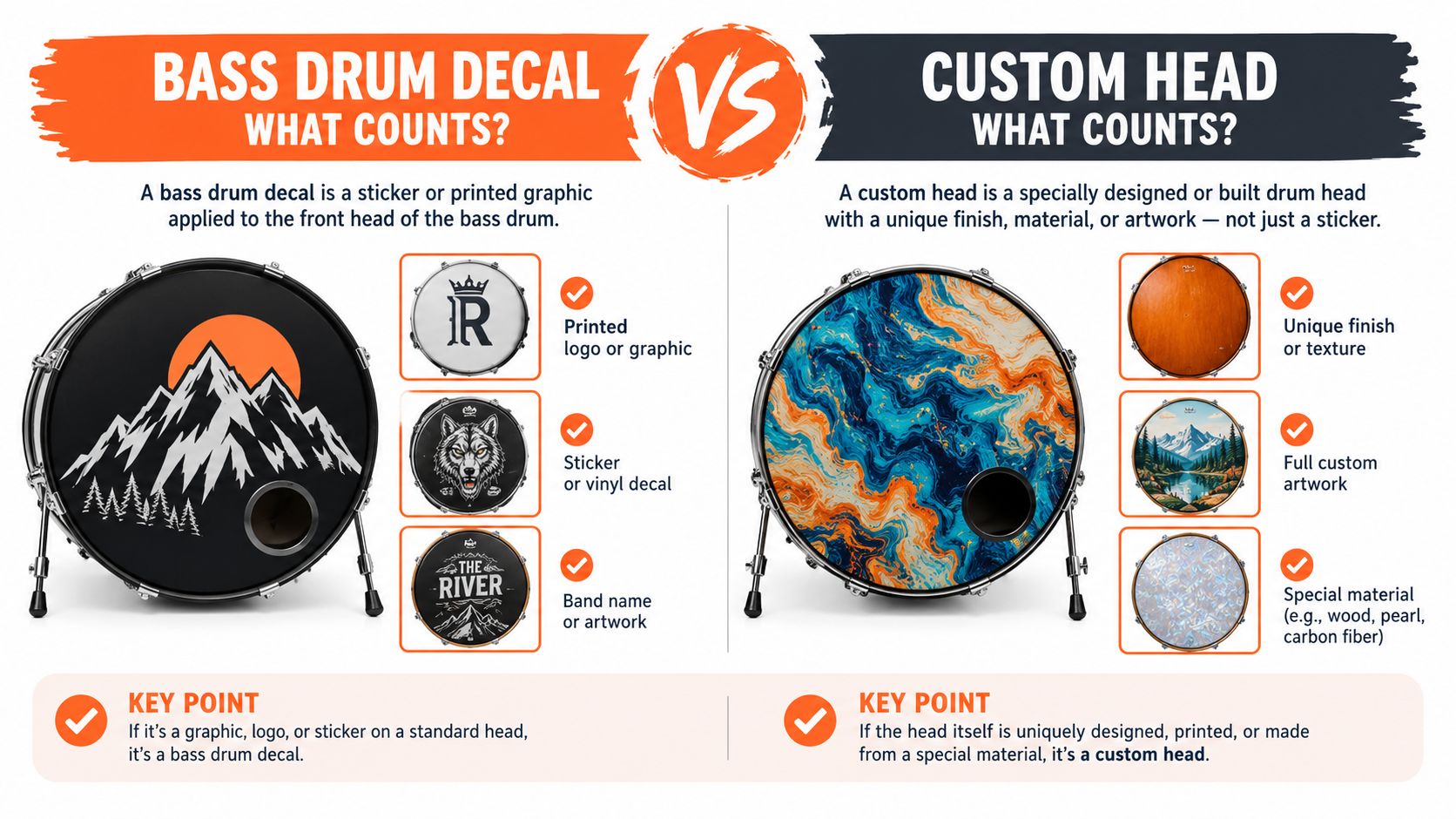
A bass drum decal is artwork printed on a separate film, then applied to an existing head. The head itself is still a standard product, and the graphic sits on top of it rather than becoming part of the head’s structure. In practice, that means the design can usually be removed later, which is exactly why decals make sense for some players who want reuse or temporary branding.
A custom printed bass drum head starts differently. The head is printed directly, so the artwork becomes part of the finished instrument surface instead of an added layer. That’s the core distinction, and it changes everything from install workflow to how the front head behaves after handling, transport, and repeated mounting. For an overview of decal-style options, see the decal product page.
The production difference that matters
Decals are shipped as a separate item and then installed by hand. Printed heads are produced as finished heads, cured, and ready to mount. That’s why the two options can’t be judged only by how the artwork looks on a screen, because one is a post-production graphic and the other is the drum head itself.
A simple way to think about it is this, decals decorate a head, printed heads become the head’s final face. That difference is what makes later questions about ports, bubbles, residue, and compatibility so important.
If the art needs to behave like part of the kit, the printed option is the cleaner answer. If the art needs to travel, swap, or come off later, the decal is the flexible one.
Side by Side How Decals and Custom Heads Actually Compare
The biggest mistake buyers make is treating this as a style choice. It isn’t. It’s a production choice, a maintenance choice, and, on a busy gig schedule, a reliability choice.
For a deeper process breakdown, this print-method guide is useful background on how direct-print styles differ from layered approaches.
| Bass Drum Decals vs Custom Printed Heads: Criteria Comparison | Bass Drum Decal | Custom Printed Head |
|---|---|---|
| Appearance fidelity | Can show edge lines or silvering on some surfaces | Artwork sits into the finished look of the head |
| Production method | Separate vinyl film applied after the head is made | Directly printed onto the head |
| Durability | Vulnerable to lifting at edges if install or conditions are poor | More integrated with the head surface |
| Tone and resonance | Adds a layer on top of the head | Behaves more like a stock head with printed art |
| Installation | Requires careful alignment and smoothing | Mounts like a regular head |
| Mic-port flexibility | Limited if the head already has a cutout | Port can be planned into the order |
| Sizing | Often template-based | Ordered to the exact head size |
| Cost at low volume | Can look cheaper at first glance | Usually the higher upfront purchase |
| Lead time | Often quicker | Usually takes longer because it’s a finished printed product |
Appearance and setup
A decal can look sharp on the right head, but smoothness matters a lot. If the surface isn’t right, the edges tell on the install. Printed heads avoid that problem because the artwork isn’t sitting on top of the film.
A clean design on the wrong surface still looks wrong.
That’s the part people miss. A printed head may cost more upfront, but it removes a lot of the visual risk that comes with a separate layer of film.
Durability and handling
The more the head gets moved, touched, packed, and reset, the more the decal has to hold up at the edges. A printed head doesn’t have that extra interface. The art is there from the start, so there’s no separate film to lift, shift, or leave residue behind.
Ports, size, and workflow
If a kit already uses a mic port, the port question becomes essential. Printed heads can be ordered with the port planned into the build, which is far cleaner than trying to make a decal work around a finished opening. Size is simpler too, because the head is made to spec instead of decorated after the fact.
For real-world tone considerations, the earlier bass drum tone guide helps explain why the front head choice matters beyond appearance.
Real Scenarios Where One Option Beats the Other
Some buyers should stop overthinking it and just choose the printed head. Others should buy the decal and move on. The right answer depends on how often the kit leaves the room, who’s installing it, and whether the artwork needs to survive one event or many.
| Which Option Wins by Scenario | Gig Count / Use | Head Material | Winner | Why |
|---|---|---|---|---|
| Touring band | Heavy road use, repeated load-in and load-out | Smooth printed or resonant head | Custom printed head | The graphic stays integrated through constant handling |
| Studio session player | Changing artists, projects, or looks between dates | Smooth head, often swapped often | Bass drum decal | Reusable artwork is useful when the visual needs change fast |
| High school drumline | Many drums, limited budget, volunteer labor | Stock heads, usually smooth | Bass drum decal | More visual impact per kit when labor is available |
| Church production team | Frequent visual resets, banner changes, clean stage look | Smooth head | Custom printed head | Easier to keep the front of the kit consistent and wipe-clean |
A touring band is the easiest call. Once the kit is seeing truck heat, club sweat, and constant load-ins, the head has to survive as a working surface, not a display panel. A printed head is the safer choice because there’s no extra film layer to fuss with every night.
A studio player can make a decal work better because flexibility matters more than permanence. If the same head is used for multiple artists, or if the front logo changes from one date to the next, removable artwork keeps the kit adaptable. The tradeoff is that the surface has to stay smooth and the install has to stay clean.
A drumline often wants the largest visual effect for the least money spread across many drums. In that setting, decals can be smart because the labor is shared and the goal is impact, not permanence. A church team usually lands on the printed option because the front head tends to serve as part of the room’s visual identity, and the setup has to look consistent without constant touch-up.
The True Cost of Decals Versus Custom Heads Over Time
A decal can look cheaper on the order page and still cost more by the end of the season. The reason is simple, a decal is not just a graphic, it’s a graphic plus install time, rework risk, and replacement friction when the head changes.
Custom bass drum heads move through a more predictable workflow. Production volumes have grown enough that one long-running producer founded in 1997 says it has created more than 150,000 custom bass drum heads in over 25 years, which shows how fully printed heads have moved from novelty into a normal category for bands, schools, worship teams, and event use. Modern design workflows also let players upload artwork, preview a live mockup, and send files straight to print, and raster art for drum heads is commonly built at full size with a minimum of 300 DPI for sharp results, as outlined in this production and design guide.
For pricing and order planning, the current price page is the place to check the actual size-based options.
Where the hidden cost shows up
Decals can create repeat labor. If the install goes wrong, the surface needs attention again. If the head wears out, the graphic has to come off and go back on somewhere else, or be replaced. If the port is wrong, the fix isn’t elegant.
Shop-owner rule: the cheaper front-end choice stops looking cheap the moment it has to be done twice.
That’s why a printed head often feels more expensive at the beginning but more stable over time. It’s not because the artwork is magical, it’s because the purchase is fewer separate steps. For players who reorder often or use a front head as part of their brand, predictability beats a small first-order savings.
Quick Decision Checklist for Choosing Your Option
Start with the head surface
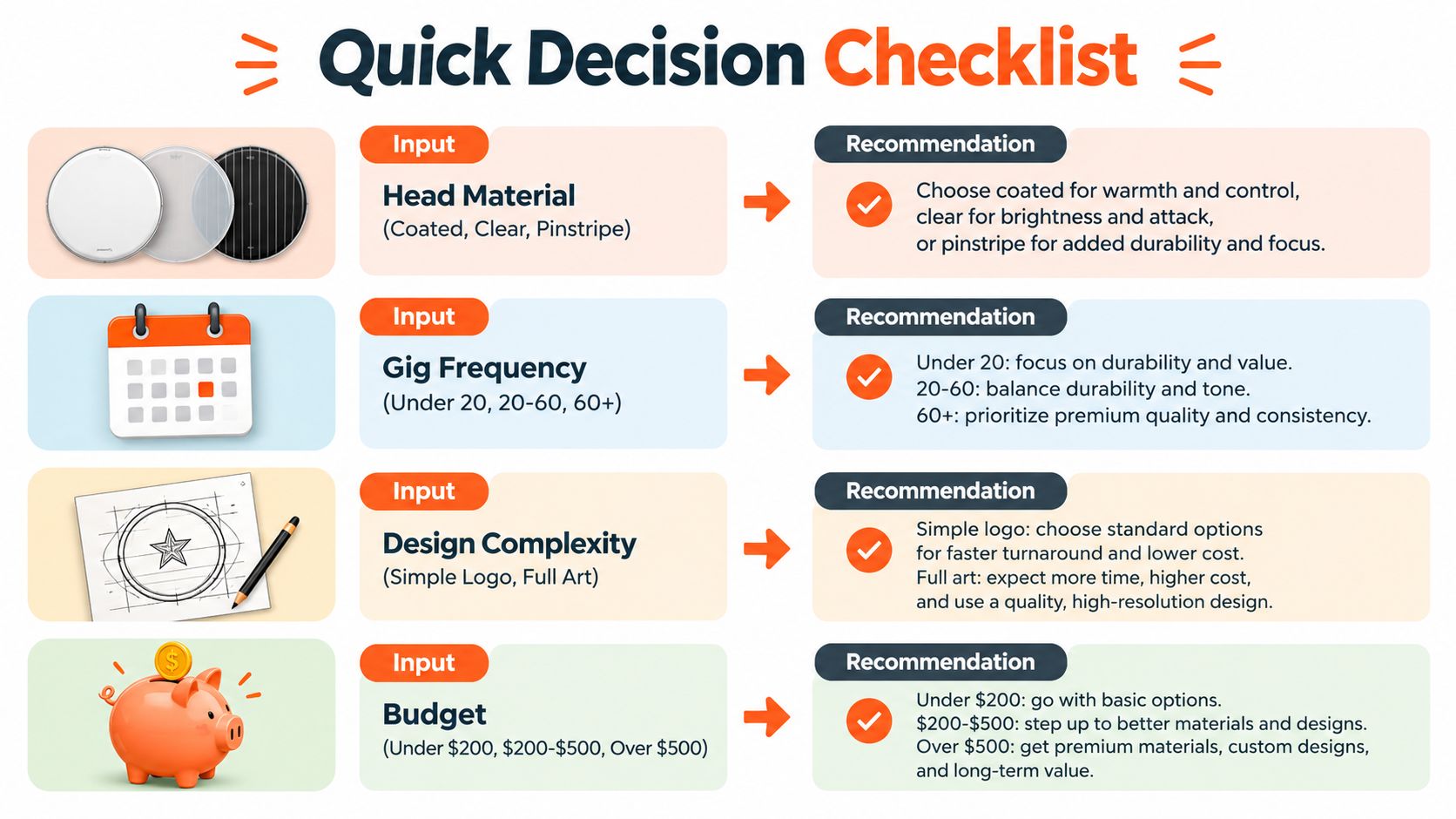
- Coated or textured head: choose a printed head if the graphic needs to stay put. Decals are designed for smooth surfaces, so they start to fail here.
- Smooth clear head: either option can work, so the decision shifts to how often the art changes and how much handling the kit gets.
- Head already has a port: lean printed, because the port and the graphic can be planned together instead of patched around later.
Then answer the usage question
- Under 20 shows a year: a decal usually makes sense if the artwork is temporary or reused elsewhere.
- 20 to 60 shows a year: printed heads start to make more sense because the setup time and touch-up risk matter more.
- Over 60 shows a year: printed heads usually win because the artwork has to survive routine handling, not just the first install.
Check the design and timeline
- Simple logo, short run, temporary branding: decal.
- Full art, band branding, or a front head that has to look finished from across the room: printed head.
- Rush job in under a week: decal if the surface is compatible.
- Standard turnaround with room for proofing: printed head.
Finish with two yes or no questions
- Does the design need to move from head to head? If yes, decal.
- Does the head need a mic port, exact placement, or a fully integrated finish? If yes, printed head.
For buyers who want the graphic handled as part of the finished drum head rather than an add-on, a custom-printed option through Custom Bass Drum Head is the more direct path.
Common Questions and Your Next Step Toward a Custom Head
Artwork prep is where a lot of bad orders start, and the fix is simple. Files should be built cleanly at 300 DPI for print sharpness, and the design should be prepared in CMYK rather than assuming a monitor preview will match the final result. A live mockup helps, but screen color and print color are never the same thing, so the file has to be treated like a print job, not a social media image.
Mic ports deserve the same blunt treatment. A working front head often uses a 5-inch port as a practical center point, while larger external mic setups can call for a 7-inch opening, depending on how the kit is being used. If the port sits off-center, it should be planned before the head is printed, not negotiated afterward.
The cleanest fix is almost always the one that gets designed in before the head ever ships.
A kit can move from a decal to a printed head later without replacing the whole drum. Peel the decal, clean any residue, and mount the new head. That switch is one of the main reasons the printed option makes sense for bands that start with a temporary graphic and later decide the front of the kit needs to look finished all the time.
If the goal is a front head that matches the band, survives real use, and stops the cycle of reapplying art every time the head changes, the printed option is the better long-term buy. A decal still has a place, but it should earn that place through flexibility, not because it looks cheaper on the first invoice.
Custom Bass Drum Head prints your artwork directly onto premium drum heads, so the design, port placement, and size all get handled as one finished order instead of a separate add-on. If the choice between a decal and a printed head still comes down to how you use the kit, visit Custom Bass Drum Head and start building the head that fits the way you play.