The trailer schedule is locked. Uniform pieces are in production. The drill is taking shape, and the percussion staff is staring at a bass line that still looks unfinished from the front sideline. That’s usually the moment the resonant heads move from afterthought to priority.
For a competitive ensemble, a drum corps bass drum head isn’t just decoration. It’s part of the corps identity every judge, parent, booster, and fan sees from the lot to retreat. It also has to survive transport, weather, repeated tuning, and the visual demands of a full season without turning into a warped, muddy-looking liability.
A clean custom head does two jobs at once. It gives the bass line a unified face, and it supports the sound and response the section needs on the field. If either side gets ignored, the whole package suffers. A great design printed on the wrong head won’t hold up. A durable head with weak artwork won’t read from the stands.
Your Corps Visual Identity Starts Here
A familiar scenario plays out every season. The staff has a strong program concept, the guard palette is approved, and the uniforms are coordinated. Then someone holds up a mockup of the bass line and realizes the front ensemble branding is sharp, but the largest moving visual block on the field still looks generic.
That gap matters. Bass drums carry brand recognition in motion better than almost anything else in the battery. They face the box, they rotate through drill, and they create repeated visual hits throughout the show. When the heads are handled well, the line looks intentional. When they aren’t, the corps can feel pieced together even if the performers are excellent.
What directors usually need from the front head
Most ensemble buyers aren’t asking for a novelty print. They’re trying to solve several problems at once:
- Brand clarity so the corps mark reads cleanly at distance
- Consistency across the full bass line, even when drum sizes change
- Durability for outdoor use, loading, unloading, and long rehearsal blocks
- A finish that looks professional under sun, stadium lights, and close-up photos
Practical rule: If the front ensemble branding is tight and the bass line still looks like stock gear, the corps visual package feels incomplete.
The strongest custom orders start with that reality. The bass drum head becomes part of the ensemble system, not a last-minute accessory. The best staff teams treat it the same way they treat uniform trim, vehicle wraps, floor graphics, and show logos. It has to match the identity already being built elsewhere.
Good heads support the whole production
A competitive battery doesn’t need visual clutter. It needs something readable, balanced, and built for motion. The logo should still look strong when a player is on the move, not only in a straight-on product mockup. That means the design decision is never just about “what looks cool.” It’s about what survives distance, light, weather, and curved surfaces.
That’s the key buying question. How does an ensemble order custom bass drum heads that look sharp, sound right, and hold together through a season? The answer starts with size and sound before artwork ever gets approved.
Sizing and Sound for a Unified Bass Line
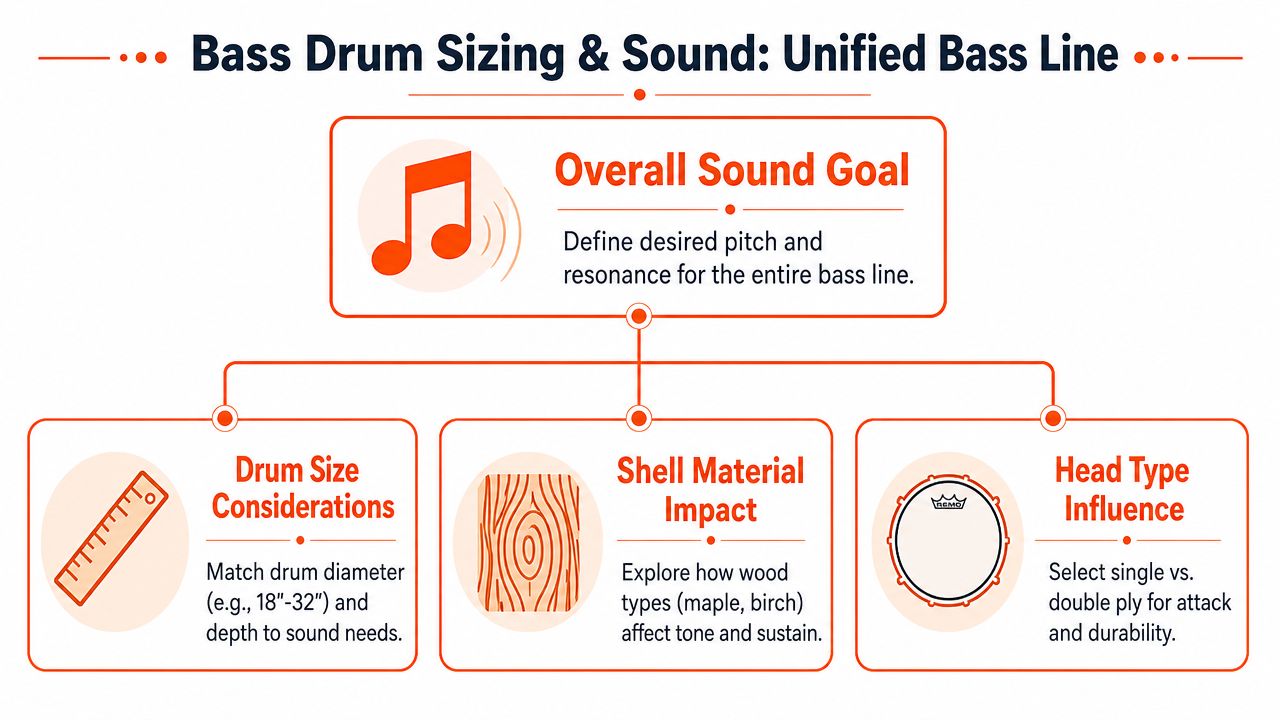
A bass line isn’t one instrument repeated several times. It’s a pitched family. That’s why sizing decisions affect more than logistics. They shape interval spacing, visual proportion, and how much usable space the front head gives the designer.
Modern drum corps sizing has shifted hard toward a more compact top drum. The standard size for the #1 bass drum is 18 inches, while the largest bass drums used are 32 inches, and that reflects a wider change in marching percussion standards where the 18-inch bass has become a dominant configuration in elite ensembles, according to this drum corps sizing discussion.
Start with the line, not the individual drum
Staffs sometimes review each head size as a separate purchase. That creates visual drift fast. The better method is to view the whole line as one coordinated front.
Three decisions matter first:
-
Diameter spread
A wide size spread gives the arranger and tuner more room, but it also changes how the artwork scales from smallest to largest shell. -
Canvas balance
Small heads can choke detailed logos. Large heads can make the same logo look undersized and empty if the layout isn’t adjusted. -
Role clarity
The batter side serves the player. The resonant side serves both the ensemble sound and the audience-facing identity.
A smart ordering process starts with exact measurements. Before approving any art, staff should confirm every drum diameter against the inventory. A quick reference like this guide to measuring drum heads helps avoid the classic mistake of designing to assumed sizes instead of the drums that will be worn.
The front head has a sound job too
It’s easy to treat the logo side like pure branding, but that side still contributes to response and resonance. On a field line, the resonant head has to work with the tuning scheme instead of fighting it. If the front head is chosen only for appearance, the section can lose clarity or consistency.
A unified look only works when the line also speaks as one instrument.
That’s why strong ensemble buyers think in pairs. They ask what each drum needs acoustically, then check whether the visual treatment still works across the full progression. The smallest head may need a simpler layout. The largest may need more negative space than expected. Matching doesn’t always mean identical sizing of every graphic element.
What works and what doesn’t
A few patterns show up every season.
| Choice | What works | What doesn’t |
|---|---|---|
| Graphic scaling | Adjusting layout by drum size while preserving the identity | Forcing one exact art footprint on every diameter |
| Bass line progression | Building the set around interval spacing and visual proportion | Picking sizes only because they’re available |
| Front head planning | Treating the resonant side as both sonic and visual equipment | Treating the logo head like a disposable decal surface |
The polished lines are rarely accidental. Someone checked the pitch plan, the visual read, and the print area together. That’s the difference between a line that looks ordered and one that looks assembled.
Choosing Materials for Maximum Durability
Touring exposes every weakness in a head choice. Sun bakes the front sideline. Moisture rolls in overnight. Equipment gets loaded, stacked, rolled, and bumped. A head that looks fine in a controlled room can become a problem halfway through the season.
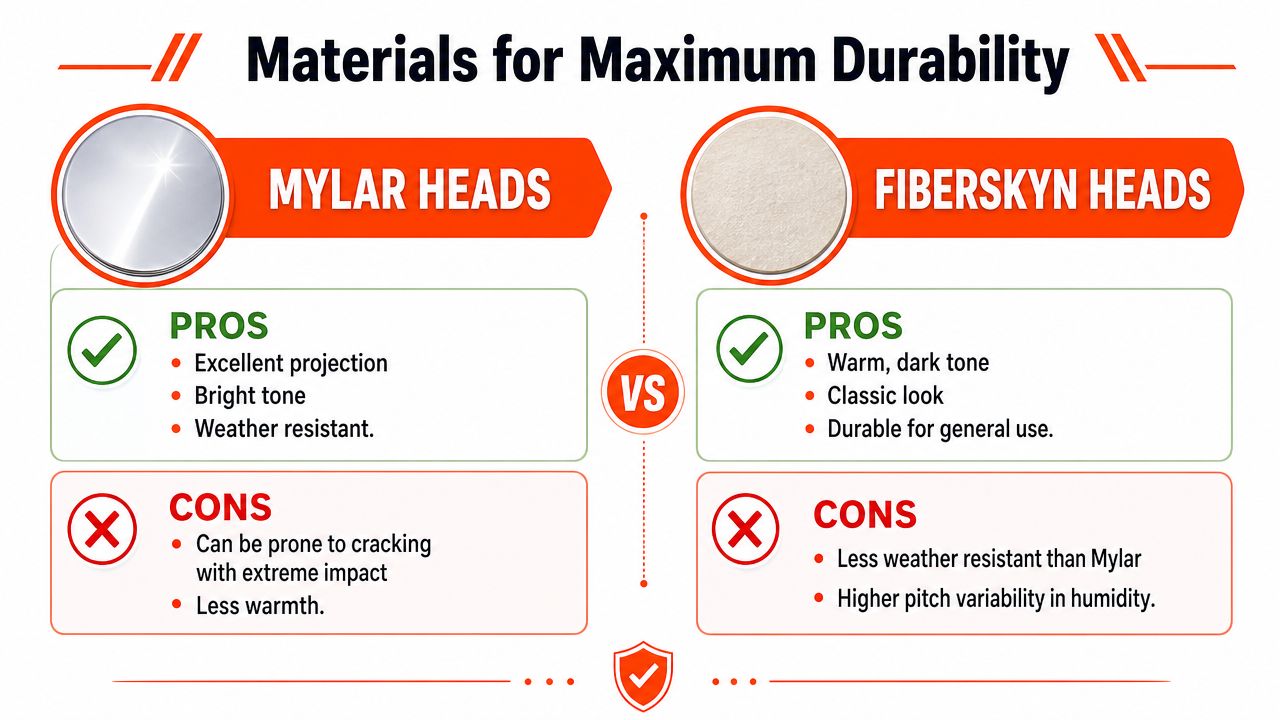
For marching use, bass drum heads are typically made from plastic, specifically 2-ply uncoated transparent film, because that construction offers durability and a consistent tone outdoors. The same reference notes that the 2-ply build gives a more prominent attack and greater resistance to weather rigors, which is exactly why this style became the modern standard for marching applications in this bass drum materials overview.
Why modern marching lines lean toward plastic film
Competitive ensembles need predictability more than nostalgia. A head that reacts wildly to changing field conditions creates work for the techs and inconsistency for the players. Plastic film became the working standard because it’s built for that environment.
That choice affects several practical areas:
- Tuning stability under changing outdoor conditions
- Attack definition so split parts stay present
- Physical durability during rehearsal, travel, and performance days
- Print compatibility for a cleaner custom graphic result
A useful companion read is this comparison of screen printed and direct printed drum heads, especially for staffs deciding how visual treatment interacts with the head itself.
The trade-off most groups get wrong
Some buyers chase a look first and assume the material question can be solved later. That usually backfires. The material and the print approach are connected. If the base head isn’t suitable for repeated outdoor use, no artwork will save the order.
The front head has to earn its place on the field before it earns its place in the photo gallery.
That doesn’t mean every line needs the same feel or response. It means the material choice should be driven by field reliability. A competitive ensemble needs a head that holds up under repeated use and still presents the graphic cleanly after long rehearsal days.
A simple decision filter
When evaluating options for a corps line, staff should ask:
- Will this hold tuning behavior consistently enough for the full line?
- Will the attack stay clear enough for ensemble definition?
- Will the face of the head stay presentable after transport and outdoor exposure?
If the answer to any of those is uncertain, the material probably isn’t right for a group order. A single indoor use case is one thing. A touring or competitive line is another.
Designing Artwork for Field-Level Impact
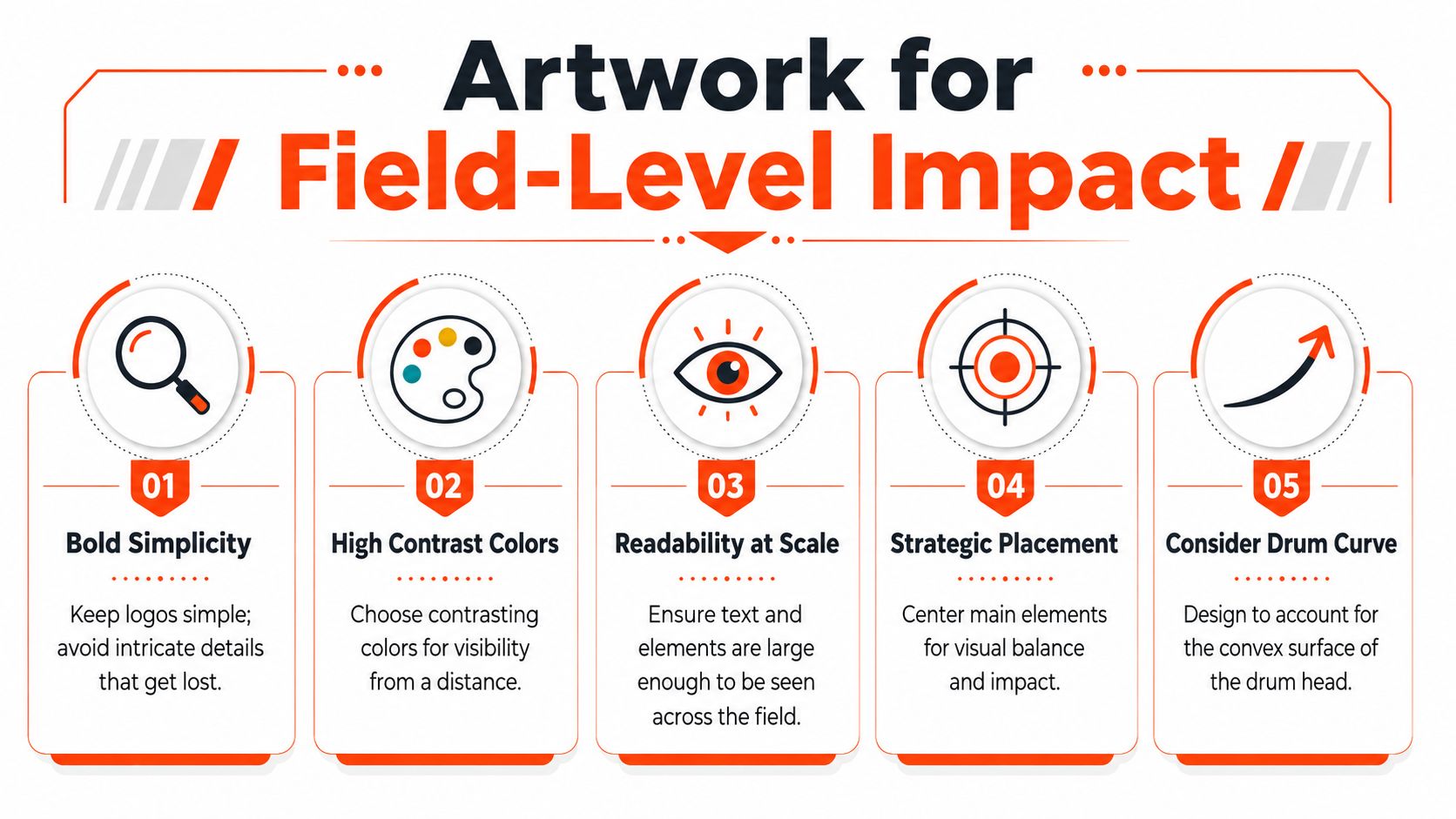
The most common artwork mistake isn’t bad taste. It’s designing for a laptop screen instead of a football field. Fine detail, subtle gradients, thin outlines, and low-contrast palettes can look impressive in a digital file and nearly vanish once the line moves past the 45-yard line.
A good drum corps bass drum head design reads fast. It doesn’t ask the audience to study it. It presents a mark, a shape, or a phrase with enough contrast and scale that the identity lands immediately.
Design for distance, not for approval meetings
The stands are unforgiving. The logo has to survive angle, glare, movement, and the curved face of the drum. That means simplification usually helps.
The strongest field graphics usually share these traits:
- Bold shapes that read at a glance
- Clear separation between foreground and background
- Strong negative space so the design doesn’t clog up
- Minimal small text, or no text at all unless it’s large enough to carry
A corps seal, mascot, or monogram often works better than a full lockup copied straight from a website header. If text is necessary, it should be treated as a visual block, not as a paragraph.
File prep rules that save headaches
Print quality starts before the file ever gets uploaded. For custom graphic heads, artwork should be delivered in CMYK at 300dpi, lighter artwork is recommended over dark graphics because dark designs absorb more heat and can cause thermal distortion and tuning instability on sunny days, and vector formats are best for scaling without quality loss, according to these bass drum head art specifications.
Those requirements aren’t cosmetic. They protect both print fidelity and field function.
A few practical standards separate clean orders from frustrating ones:
Use vector whenever possible
Vector art scales cleanly across multiple drum sizes. That matters for a bass line where the same identity may need to fit a range of head diameters without turning soft or jagged.
Raster files can still work, but only if they’re prepared correctly. Low-resolution artwork almost always looks worse on larger heads than buyers expect.
Keep the palette smart for outdoor use
Dark, heavy artwork can look aggressive in a proof. Under sun, it can create problems. Lighter overall artwork handles outdoor heat more gracefully and tends to stay visually cleaner from a distance as well.
Respect the curve of the head
A circular design space changes alignment. Elements placed too close to the edge can feel distorted. Text on a curve can get awkward fast. The center usually carries the visual load best.
For more layout examples specific to school and field ensembles, these marching band drum head design ideas are useful when a staff needs inspiration without overcomplicating the concept.
Design note: If the logo needs a verbal explanation to be understood from the box, it’s too complicated for the front of a moving bass line.
Direct printing beats add-on graphics
For corps use, printing directly onto the head is the professional route. Added films and stickers create two recurring problems. They can fail physically, and they can interfere with the clean, integrated finish a competitive line needs.
Direct printing avoids the edge-lift look that cheapens a visual package. It also keeps the head looking like a purpose-built part of the instrument, not an attachment. For a corps identity, that difference shows up immediately in photos, videos, and live performance.
The Process from Digital File to Finished Head
Ordering custom heads feels complicated when the ensemble treats it like a special fabrication project. It gets much easier when the process is broken into decisions the staff already understands. Size. artwork. head type. layout approval. final order.
The useful part of a modern online workflow is control. Staff can see the design on the head before it goes to print, catch scaling issues early, and keep the visual package consistent across the line.

A clean ordering sequence
Most successful ensemble orders follow a sequence like this:
-
Confirm each drum size
Build the order from the actual inventory, not memory or old paperwork. -
Prepare one master art direction
Decide whether the entire line uses one unified face or size-adjusted variations of the same mark. -
Upload the production file
At this stage, clean prep pays off. Proper color mode and resolution prevent rework. -
Review the mockup carefully
Check centering, edge spacing, and how the artwork reads on different diameters.
A practical visual planning reference is this article on custom bass drum head graphics, especially for directors trying to standardize artwork decisions across a larger staff team.
Mic port placement needs a plan
Some ensembles need a port. Some don’t. The key is deciding before the artwork is finalized, not after. A mic port changes the face of the design. If it gets added as an afterthought, it can cut through the logo or throw off the visual balance.
Common placement approaches include lower-left or lower-right positions so the main center graphic stays intact. The correct choice depends on the miking strategy, stand placement, and how much visual interruption the design can tolerate.
A good review process checks three things at once:
- Will the port interfere with the primary visual mark
- Will the chosen location support the ensemble’s audio setup
- Will the placement remain consistent across the line where needed
Some of the worst-looking custom heads started as good artwork and got ruined by late port decisions.
Approval should be boring
That’s the goal. By the time the order is approved, there shouldn’t be any drama left. The mockup should match expectations, the sizes should be verified, and everyone involved in the purchase should know exactly what’s arriving.
The more disciplined the digital review is, the fewer surprises show up on delivery day. That matters even more for a corps order than a single-drum order because one mistake gets multiplied across the whole line.
Ordering Logistics for Your Entire Ensemble
Buying one custom head is a design task. Buying for an entire bass line is an operations task. That shift matters. The order has to align with rehearsal calendars, school or corps approval processes, delivery timing, and whoever is signing off on the budget.
The ensembles that handle this well usually make one smart move early. They stop treating the order as a last-minute visual extra. Once heads become part of the season production plan, the process gets calmer and the result gets better.
Group orders fail for predictable reasons
It usually isn’t the artwork. It’s coordination.
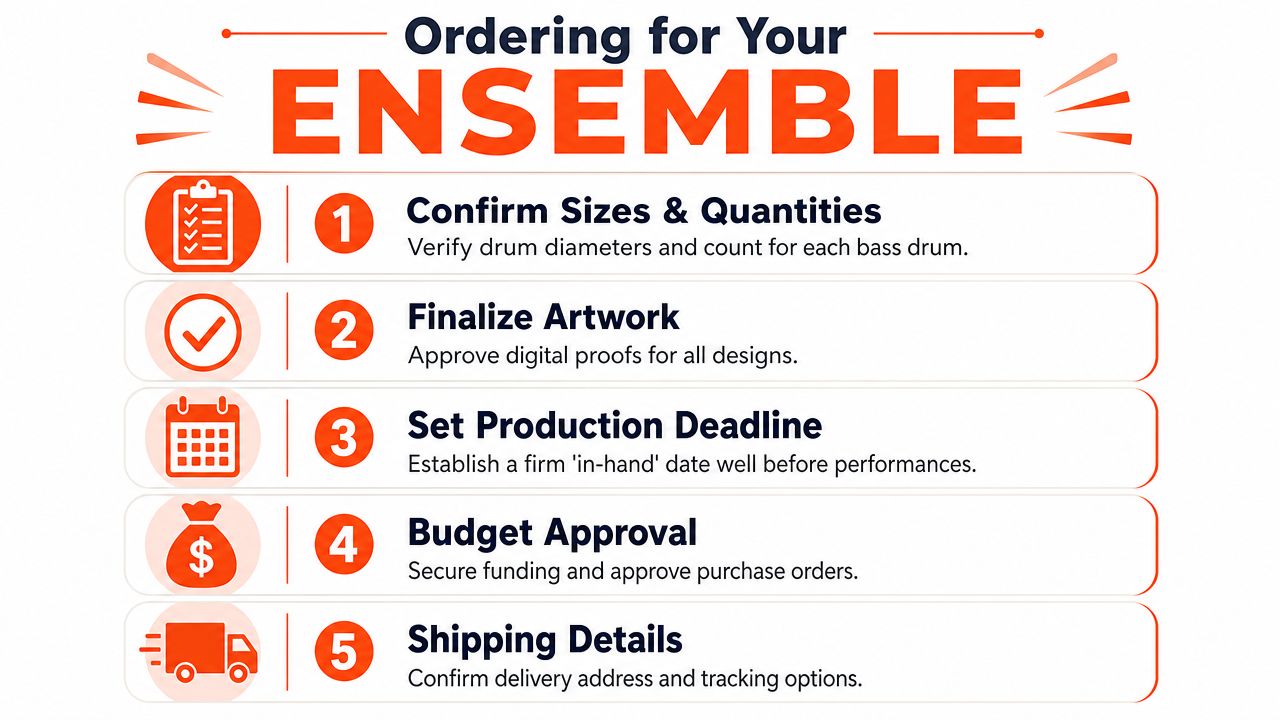
A full-line purchase gets delayed when one of these gets ignored:
- Size confirmation from the actual drum inventory
- Final art approval from the director or design lead
- Purchase authorization from administration, boosters, or finance
- Shipping details that identify the right delivery window and destination
A useful planning resource for procurement teams is this guide to choosing a custom drum head printing company, especially when the buyer needs a checklist for comparing process reliability rather than just design features.
Why planning ahead pays off
Rush ordering creates expensive mistakes even when no price changes are involved. It shortens proof review, limits time for corrections, and can leave the line installing heads right before a performance block. That’s avoidable.
A better workflow looks like this:
| Stage | What the ensemble should lock down |
|---|---|
| Early planning | Drum counts, diameters, concept direction |
| Art approval | Final file, color decisions, port decisions if needed |
| Procurement | Funding approval, purchaser details, delivery plan |
| Pre-event buffer | Enough time for inspection and installation before the first show |
Good logistics make the heads feel easy. Bad logistics make even a good product feel risky.
Bulk ordering should preserve consistency
A line order should come from one approved visual standard. If different people send different files, or if sizes are ordered in separate batches without a clear reference, matching can drift. The audience may not identify the problem consciously, but the line won’t look fully unified.
That’s why one buyer, one approved file set, and one confirmed size sheet usually produce the best result. Competitive ensembles spend too much time refining details on the field to let the front face of the bass line be decided casually.
Take the Field with Confidence
A professional drum corps bass drum head is never just a printed circle. It’s the meeting point between sound, durability, and corps identity. The line has to look unified from the box, survive outdoor use, and support the musical job the drums are there to do.
The staffs that get this right make a series of disciplined choices. They verify sizes before building art. They choose materials that can handle field conditions. They design for distance, not just for a screen. They review mockups carefully and treat ordering as part of the production calendar instead of a late add-on.
That combination is what makes a bass line feel finished. Not flashy. Finished. The front of the drums belongs to the same visual world as the uniforms, the show design, and the ensemble’s reputation.
When those pieces line up, the heads stop looking like accessories and start reading like part of the corps itself. That’s where the professional edge shows up.
Ready to outfit the full line with custom heads that look sharp and arrive field-ready? Custom Bass Drum Head makes it easy to upload artwork, review a live mockup, and order custom-printed bass drum heads for competitive ensembles with a clean, controlled process.